← Home

MSC AI & DATA SCIENCE / MODULE 01

Programming for Data Science

Python programming, data preparation, graphs and the discipline of building reproducible analytical work.

THE PRACTICE BEHIND THE MODULE

What I take into the work

A data structure is a choice about what relationships are visible. I pair code with a question, a documented source and checks that make the analysis inspectable. Python is particularly good at finding the assumptions I forgot I had made.

Python programming, data preparation, graphs and the discipline of building reproducible analytical work.

FROM THE SOURCE REFLECTION

Course reflection

My account of the learning and its application, distilled from my combined course reflection. The original document is held privately.

  1. Graph theory became practical through Python and NetworkX: data preparation, category definitions and visualisation changed what a network could responsibly show.
  2. Learning Java alongside Python clarified language choices; testing, comments and documentation made analytical work easier to inspect and maintain.
  3. The data science lifecycle gave me a repeatable way to move from a question and source through analysis, review and handover. The workforce network remains an academic analysis of published aggregate data.

About the code: Python code and notebooks for the coded studies are privately stored and maintained by me. I’m happy to answer questions about the methods and their limits; any sharing of an artefact would depend on the permissions and data involved.

MILESTONES IN PRACTICE

From method to judgment

Three steps show how the learning moved into an artefact or decision, and where the evidence stops.

01

Structure

Translate a published aggregate staff table into categories and relationships.

02

Build

Clean labels and use Python and NetworkX to inspect and visualise the graph.

03

Interpret

Explain why category links are not person-to-person ties or causal evidence.

SELECTED PORTFOLIO EVIDENCE

Applied studies

Original summaries of my work. Each distinguishes the source, the work's stage and what it can support.

APPLIED STUDY

Higher education workforce network

Data basis
Public, real aggregate data
Stage
Completed academic analysis

I used a publicly available UK higher education staff table to explore relationships between country, occupational categories and demographic groupings with Python and NetworkX. The graph connects aggregate categories; its edges do not represent personal relationships between individual staff.

Reading the evidence
Cleaning category labels, checking counts and interpreting how graph design affects the picture mattered as much as plotting the network.

APPLIED STUDY

From notebook to repeatable method

Data basis
Same public aggregate source
Stage
Reflective technical report

A companion study documented data selection, graph construction, visualisation and the problems encountered while preparing a published dataset.

Reading the evidence
Public availability does not remove the need to test definitions, missing values and what a network can legitimately imply.

EVIDENCE & PRIVACY

These summaries do not reproduce academic submissions, restricted datasets, individual records, internal systems detail or private course materials. A design, prototype and deployed service are different stages; each study is labelled accordingly.

A CLOSER LOOK

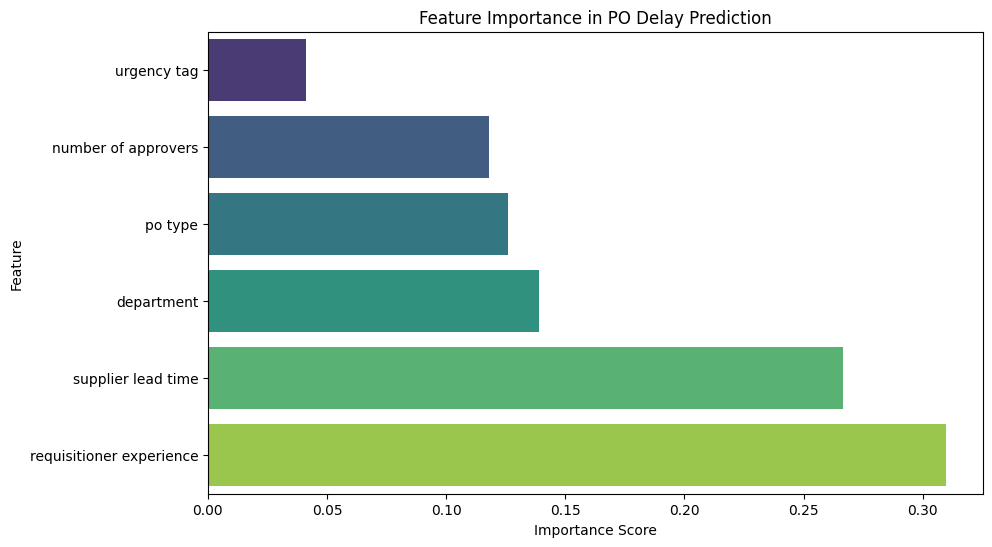
What the model relied on

What the model relied on. Original synthetic delay-model chart. Feature importance describes model behaviour; it does not establish causation.
Original synthetic delay-model chart. Feature importance describes model behaviour; it does not establish causation.
EXPLAINABLE AI & DATA / READ THE METHOD

Connect the learning to the evidence.

Use the categories to distinguish a capability, an algorithm, a Python package and a delivery step. A mention in a module or case study does not mean that capability is running on this page.

Follow the reasoning.

  1. QuestionChoose the decision to support
  2. MethodMatch the task to a suitable approach
  3. TestCompare with appropriate evidence
  4. ExplainState limits and human responsibility

Explore the building blocks.

AI Capability4
AI/Data Concepts1
Data Science Pipeline1
Evaluation & XAI2
Python Package3
Responsible AI1

Number of concepts in this guide, not performance or usage measures.

Explore the explanation matrix · 12 concepts

12 concepts shown

On small screens, scroll the table sideways. “Learning context” explains a related idea; it does not mean that method runs on this page. Deep learning is the standard term for “deep ML”.

Technical termTechnical description / definitionIn plain EnglishHow this page uses it
Machine learning (ML)AI CapabilityMethods that estimate patterns or parameters from examples to support inference on other inputs.Primary reference ↗Learn a pattern from examples, then check whether it helps with new ones.Learning context
ML learns from examples. Read the page-specific methods below to see whether any model runs here.
Deep learningAI CapabilityMachine learning using neural networks with multiple representation-learning layers.Primary reference ↗A layered model learns useful representations; more layers do not guarantee a better answer.Learning context
Deep learning is an AI capability, not a label for every chart. No deep model is implied by this explanation panel.
Natural language processing (NLP)AI CapabilityComputational methods for representing, analysing or generating human language.Primary reference ↗Help a computer work with words, while remembering that context matters.Learning context
Text search, translation, thematic classification and generation are different language tasks; their implementation is identified separately.
Sentiment analysisAI CapabilityA language-analysis task that estimates an expressed attitude, often as polarity or sentiment categories.Primary reference ↗Estimate the tone of words—not the private feelings or personality of their author.Learning context
Sentiment estimates expressed tone. It must not be confused with topic classification or a diagnosis of a person.
Data science pipelineData Science PipelineAn ordered, reproducible sequence for acquiring, validating, preparing, analysing and evaluating data.Primary reference ↗A chain from a question and source to an answer someone can check.Method guide
The learning-to-practice path connects framing, preparation, modelling, evaluation and communication.
Features and labelsAI/Data ConceptsFeatures are model inputs; labels are target values or categories used in supervised learning.Primary reference ↗What the model sees, and the answer it is learning to estimate.Learning context
Projects define relevant input features and any target labels before choosing an estimator.
Held-out evaluationEvaluation & XAIAssessment on examples excluded from fitting and model selection, according to the declared split.Primary reference ↗Keep some answers out of practice so the test means something.Learning context
Unseen and appropriately separated cases help assess whether a learned pattern generalises.
Explanation versus causal proofEvaluation & XAIA model explanation describes selected behaviour or contributions; it does not establish causal effects or full reliability.Primary reference ↗A reason for this output is useful, but it is not proof that the model is right.Responsible use
Explain what was actually done and what the available evidence supports.
NumPyPython PackageA Python library for multidimensional arrays and numerical operations.Primary reference ↗The numerical toolbox behind many Python calculations.Learning context
A numerical Python library; it is not an AI capability or an algorithm by itself.
pandasPython PackageA Python library for labelled tabular data manipulation and analysis.Primary reference ↗A programmable workbench for cleaning and comparing tables.Learning context
A tabular Python library; a useful preparation tool, not a prediction model.
scikit-learnPython PackageA Python library providing estimators, preprocessing tools and model-evaluation utilities.Primary reference ↗A toolkit of models and fairer ways to test them.Learning context
A Python library of algorithms and evaluation tools, distinct from each fitted model.
Human oversight and consentResponsible AIPeople retain appropriate review authority, permission controls and correction routes for data use and outputs.Primary reference ↗Keep someone able to question, correct or stop the result.Responsible use
Decision ownership, permission and correction belong throughout the workflow.
OSL · Olukotun Studios Ltd

Olukotun Studios Ltd · Registered in England and Wales · No. 17537910

LinkedIn ↗