The useful detail is often between the milestones: the question that reveals an owner, the exception that changes a process, or the practice session that makes a new service usable.
Earlier non-AI project work, grouped deliberately as the foundation for my current direction in AI, Data & Decision Intelligence. Discovery, requirements, governance and adoption remain essential when the solution includes AI.
The stories below describe foundational work; the two interactive exercises are new public teaching adaptations.
What the work involved.
These concise accounts are adapted from my professional reflections. They distinguish direct analysis, leadership support and proposals. Public examples omit personal records and internal operational detail.
Workstream design and BA coordination
Enquiry services: learning follows the work
I helped structure learning for a new enquiry-management service around roles, processes and support after launch.
Read more · Method, contribution and limits
I translated change material into four connected stages: analyse needs, design and develop learning, deliver it, and evaluate its use. The analysis considered role-to-task mapping, practice environments, quick reference guidance, super-user support and follow-up clinics. I also clarified how BA input could complement Change, learning teams and subject specialists. The contribution was a more usable learning approach and clearer responsibilities; the account does not establish a measured adoption uplift.
What carries forward: Test whether people can complete a meaningful task with the right support. Attendance alone cannot establish adoption.
I shaped a knowledge-management approach that connected article structure with ownership, review and feedback.
Read more · Method, contribution and limits
The proposed approach brought existing questions and operational knowledge into structured articles, categories and tags. Workshops would agree what a useful answer looks like, who maintains it and how corrections reach the right owner. Community terms, a manageable backlog and review dates connected content work to a continuing service. Usage analytics were proposed as one input to review, alongside unsuccessful searches and user feedback—not a substitute for checking whether an answer is correct.
What carries forward: A knowledgebase needs a maintenance model as much as a migration plan. Articles do not stay current simply by sitting neatly in folders.
Process discovery, facilitation and future-state analysis
Payment processes: make exceptions visible
I helped turn purchase-to-pay pain points into process views, discovery questions and an improvement agenda.
Read more · Method, contribution and limits
I used stakeholder walkthroughs, workshop prioritisation and different levels of process detail to separate the shared service picture from operational steps. Analysis considered missing information, hand-offs, receipt confirmation, invoice exceptions, ownership and communications. Related commission-process work sharpened questions about field ownership, versions, dispute routes and audit trails. These were analysis outputs and improvement options; neither a redesigned map nor a proposed automation proves that payment times fell.
What carries forward: Understand normal work and exception work before automating either.
Research operations: requirements tied to benefits
In a specialist research-operations system project, I completed requirements and benefits analysis to support procurement.
Read more · Method, contribution and limits
I consolidated functional and non-functional needs, worked with stakeholders to prioritise them, and connected proposed process changes to the groups expected to benefit. The value case included accuracy, time returned to operational work, reporting and better information at the point of use. This made the analytical foundation more suitable for procurement discussions. The public account omits sensitive research processes and tender detail, and does not claim that expected benefits were subsequently measured.
What carries forward: Qualitative benefits still need an owner, a testable change and a way to observe whether the service improved.
Direct Senior BA discovery and transition analysis
Migration discovery: find the business dependency
I helped translate a complex legacy research environment into a clearer view of ownership, use, dependencies and migration needs.
Read more · Method, contribution and limits
Discovery combined catalogue walkthroughs with questions for owners and users: what is still needed, which service depends on it, what restrictions apply, and what must work after a move? I enriched technical inventory thinking with business purpose, ownership, retention decisions and service-continuity concerns. Acceptance scenarios included both permitted access and denied access. The contribution was migration-readiness evidence and decision support—not a claim that I implemented the infrastructure or completed every migration.
What carries forward: A technically successful copy is insufficient if people cannot use the right information afterwards.
I designed a cross-functional HR–IT priorities workshop to connect competing demands, dependencies and delivery confidence.
Read more · Method, contribution and limits
Preparation combined a shared backlog, clear activity instructions and a rehearsal space. The session used structured discussion, voting, roadmap sequencing and explicit risk ownership. Follow-up mattered: record the rationale, name the next action and make unresolved dependencies visible. Related process-review work used tailored interviews, workshops and broader feedback to avoid treating the loudest voice as the whole service. Agreement in the room was a planning output, not a guarantee of delivery.
What carries forward: Capture the reason for a decision and the conditions that could change it.
I shaped a proposal for easier navigation and study-space discovery as a data, ownership and service-design problem.
Read more · Method, contribution and limits
The proposal linked room and location information with opening hours, facilities, accessibility, availability and booking rules. I developed a business case, executive summary and phased route through discovery, data modelling, service design, pilot and possible scale-up. Success measures were proposed around finding a suitable space and the reliability of information. This was front-end transformation shaping; it is not a claim that a live navigation service or predictive availability engine was delivered.
What carries forward: A useful interface depends on information that someone can keep accurate.
AI-generated editorial illustration of an imagined workshop; not a photograph of a project, institution or named colleague.
A METHOD THAT TRAVELS
Connect the chain. Keep the human decision.
NeedWhose task is difficult?
EvidenceWhat do we actually know?
RequirementWhat must change?
AcceptanceHow will we test it?
ValueWhat will we observe?
Traceability helps people challenge a proposed change. It does not turn an assumption into evidence or an expected benefit into a measured result.
EXPLORE / CHALLENGE / CONNECT
Evidence Chain Studio.
For analysts and delivery leads: rehearse the link from a user need to acceptance and a follow-up measure. Select a fictional case, change the evidence available and inspect the gaps.
Read more · Method and decision limits
Audience and value: Beginner through experienced BAs, service owners and delivery leads; tactical assurance and strategic benefits discussion.
Method: Five explicit Boolean evidence checks. Discovery needs a reviewed need and an owner; pilot discussion additionally needs data and acceptance checks; a benefit discussion also needs a baseline plan. The display reports which of those prerequisites are missing. All five checks are needed for full coverage, but none certifies delivery readiness.
Implementation: Deterministic JavaScript rules over six authored scenarios; no machine learning, Python libraries or institutional connection. Selecting a case resets the evidence assumptions. No input is sent or saved.
Limits: Checking a box does not verify the evidence. Even a complete chain cannot establish a benefit without actual observations, a credible comparison and consideration of other causes. Legal, security and domain approvals remain separate.
LEARNING / PRACTICE / SUPPORT
Adoption Capacity Planner.
For change leads, BAs and learning teams: compare fictional delivery options and the facilitator time they require. Capacity is one constraint; confidence and adoption still need observation.
Read more · Arithmetic, assumptions and value
Audience and value: Change managers, learning leads and BA consultants; operational scheduling and tactical resourcing. This is a planning calculator, not an adoption prediction.
Method: Groups = ceiling(people ÷ maximum group size). Core live time per group = learning minutes × format share (100%, 50% or 0%) ÷ 60. Required facilitator hours = preparation + groups × (live time + clinic minutes ÷ 60). Each group receives one clinic. Self-study time is allocated to learners, not removed from the learning requirement.
Assumptions: One facilitator, all groups attend, the same preparation is reused, sequential delivery, no repeat sessions, travel or administration. Participant time = people × (core learning + clinic minutes) ÷ 60. Change the inputs to explore alternatives; these are not workplace measurements.
Implementation: Browser-local JavaScript arithmetic and authored role prompts. No AI model or Python training pipeline. No input is transmitted or stored; downloads contain only this fictional plan.
Limits: A smaller time total may be unsuitable for the audience. Budget accessibility, content design and support explicitly. Demonstrated task performance, follow-up and service outcomes are needed to evaluate adoption; this calculator cannot certify it.
A professional reference, not a rigid script.
IIBA’s BABOK® Guide and The Business Analysis Standard provide wider professional context. The exercises here are my independently authored teaching adaptations, not IIBA assessment or certification tools.
Workshops that leave useful evidence
A workshop needs a clear purpose, the right participants and a usable output. Preparation, accessible participation and follow-through matter as much as facilitation in the room.
Read more · A refined workshop blueprint
I work backwards from the decision or artefact the group needs. Participants receive the purpose and suitable prework; silent reflection and written input give quieter voices room. During the session, I distinguish facts, assumptions, decisions and unresolved disagreements. Afterwards, the record names actions, owners and dates for confirmation. Requirements then connect the need to acceptance criteria, tests, evidence and adoption.
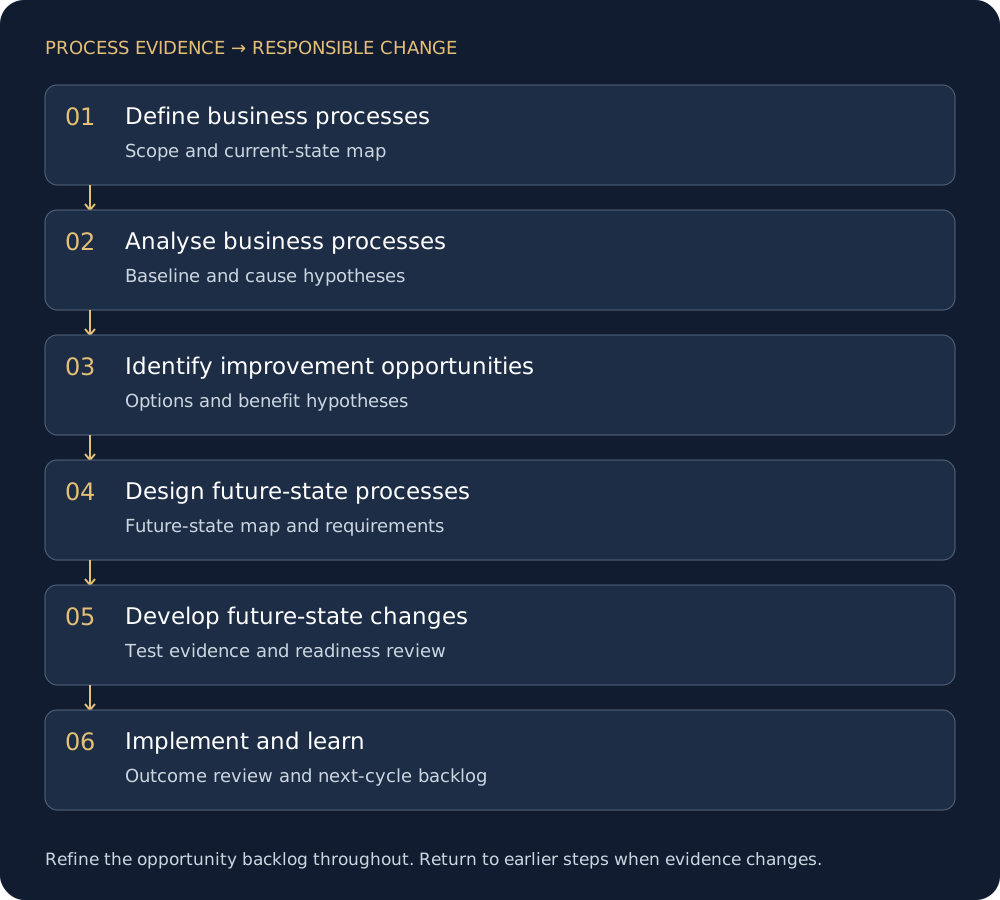
Six steps from process evidence to responsible change.
In December 2022, I developed a process re-engineering framework and accompanying six-step diagram for the BA function. The useful thread remains: understand the work, investigate what limits it, design a better way and follow the change through to outcomes. This is an adaptation of an authored framework, not evidence that every proposed change was implemented or achieved its targets.
Today I connect that foundation to data quality, integration, responsible AI and adoption. AI is one option within the improvement cycle; sometimes clearer ownership, better configuration or a simpler process is the stronger answer.
Refined from my earlier framework and Visio model. Open the diagram for a larger view.Read more · The framework, stage by stage
1. Define business processes
Map the outcome, trigger, endpoint, roles, systems and rules. Agree whose experience and evidence are needed. Working output: Scope and current-state map.
2. Analyse business processes
Investigate delays, rework and unclear ownership. Test causes against evidence; distinguish elapsed time from time spent doing the work. Working output: Baseline and cause hypotheses.
3. Identify improvement opportunities
Compare simpler processes, clearer ownership, configuration, integration, automation and AI where justified. Maintain an opportunity backlog. Working output: Options and benefit hypotheses.
4. Design future-state processes
Describe the proposed handoffs, decisions and exceptions. Connect data requirements, human review, acceptance criteria and continuity arrangements. Working output: Future-state map and requirements.
5. Develop future-state changes
Build and test the agreed changes, prepare instructions and training, and assess failure and recovery cases. Make unresolved risks visible. Working output: Test evidence and readiness review.
6. Implement and learn
Introduce changes with accountable owners, monitor outcomes and adoption, and use evidence to continue, revise or stop. Feed lessons back into the backlog. Working output: Outcome review and next-cycle backlog.
Read more · Before, during and after stakeholder engagement
Before: Agree the question, decision owner, scope and intended output. Invite people who perform and support the work, prepare accessible prework and request only appropriate evidence.
During: Map a real or clearly fictional case. Explore exceptions, handoffs and disagreements. Separate observed facts, assumptions, proposals and decisions. Ask what would change someone’s assessment.
After: Confirm actions, owners and review dates. Trace requirements to acceptance criteria and evidence. Revisit the baseline and adoption after the change; a workshop or completed diagram alone is not an outcome.
Read more · What the data and AI lens adds
Process mining needs usable event identifiers, activity names and timestamps, together with a defensible case boundary. Missing or inconsistent logs can misrepresent the work. Predictive models need suitable outcomes, representative data and evaluation against a simpler baseline. An agent needs explicit permissions, human review, exception handling and a way to stop.
Diagramming tools communicate a process; the diagram itself does not execute it. A simulation explores assumptions; calling it a digital twin requires more than copying a flowchart. Incremental improvement and substantial re-engineering both have a place: choose the scale of change that the evidence and circumstances support.
Source basis: owner-authored framework, version 1.0 dated 12 December 2022, and its six-step diagram. Public wording is newly adapted; original internal drafts, reviewer details and approval placeholders are not published. The method is educational and does not certify a regulated process.
Personal tool suggestions
Enable JavaScript to choose optional feedback-based suggestions.
EXPLAINABLE AI & DATA / READ THE METHOD
Clear logic behind the working draft.
These public workbenches organise inputs through authored rules, templates and calculations. A generated worksheet is a draft to review, not an autonomous consultant.
Follow the reasoning.
FrameState the need and evidence
OrganiseApply the selected rules or template
InspectReview the draft, diagram or comparison
DecideA person owns the next action
Explore the building blocks.
AI Capability5
Algorithm1
Data Science Pipeline2
Evaluation & XAI1
Responsible AI1
Visualisation1
Number of concepts in this guide, not performance or usage measures.
Explore the explanation matrix · 11 concepts
11 concepts shown
On small screens, scroll the table sideways. “Learning context” explains a related idea; it does not mean that method runs on this page. Deep learning is the standard term for “deep ML”.
Technical term
Technical description / definition
In plain English
How this page uses it
Rule-based logicAlgorithm
Explicit authored conditions map inputs to outputs without fitting parameters from training examples.Primary reference ↗
A transparent set of if-this-then-that instructions.
Running here Browser controls select authored methods and structure the visitor’s inputs; they do not train a model.
Data science pipelineData Science Pipeline
An ordered, reproducible sequence for acquiring, validating, preparing, analysing and evaluating data.Primary reference ↗
A chain from a question and source to an answer someone can check.
Method guide The workflow connects evidence, analysis, a proposed action and an accountable reviewer.
Visual encodingVisualisation
Mapping values or categories to marks, position, length, colour and labels.Primary reference ↗
Make the comparison visible, with a scale and a clear label.
Running here Diagrams and summaries represent entered information or labelled illustrative examples.
Data quality checksData Science Pipeline
Validation of completeness, allowed values, uniqueness, types and consistency with expected constraints.Primary reference ↗
Check missing, repeated and impossible entries before trusting a chart.
Method guide Completeness and review prompts help expose gaps; they cannot certify the underlying evidence.
Explanation versus causal proofEvaluation & XAI
A model explanation describes selected behaviour or contributions; it does not establish causal effects or full reliability.Primary reference ↗
A reason for this output is useful, but it is not proof that the model is right.
Responsible use A structured output shows its method, but the visitor must check the claims and context.
Human oversight and consentResponsible AI
People retain appropriate review authority, permission controls and correction routes for data use and outputs.Primary reference ↗
Keep someone able to question, correct or stop the result.
Responsible use People review and adapt drafts before any operational use.
Large language model (LLM)AI Capability
A language model trained on substantial data to estimate and generate token sequences from context.Primary reference ↗
A fluent drafting partner whose statements still need checking.
Learning context An LLM can assist drafting in an approved environment; these public rule-based workbenches do not silently call one.
Machine learning (ML)AI Capability
Methods that estimate patterns or parameters from examples to support inference on other inputs.Primary reference ↗
Learn a pattern from examples, then check whether it helps with new ones.
Learning context ML learns from examples. Read the page-specific methods below to see whether any model runs here.
Deep learningAI Capability
Machine learning using neural networks with multiple representation-learning layers.Primary reference ↗
A layered model learns useful representations; more layers do not guarantee a better answer.
Learning context Deep learning is an AI capability, not a label for every chart. No deep model is implied by this explanation panel.
Natural language processing (NLP)AI Capability
Computational methods for representing, analysing or generating human language.Primary reference ↗
Help a computer work with words, while remembering that context matters.
Learning context Text search, translation, thematic classification and generation are different language tasks; their implementation is identified separately.
Sentiment analysisAI Capability
A language-analysis task that estimates an expressed attitude, often as polarity or sentiment categories.Primary reference ↗
Estimate the tone of words—not the private feelings or personality of their author.
Learning context Sentiment estimates expressed tone. It must not be confused with topic classification or a diagnosis of a person.
No matching concepts. Choose another category or clear the search.