SELECTED WORK / 01 · ENTERPRISE AI
Meeting Planning Agents
A bounded enterprise proof of concept for meeting preparation, scheduling and follow-up, shaped around a real workflow and tested in controlled conditions.
Find the useful boundary
The team examined how assistants could prepare a meeting brief, suggest suitable times and make follow-up actions easier to review. I translated the needs of the people doing that work into testable scenarios, an evaluation approach and clear decision rights. The aim was to reduce searching and coordination while keeping the organiser responsible for the meeting.
A promising check, with a clear boundary.
- 01 / FRAMEMeeting needs became testable scenarios.
- 02 / TESTAgent roles and fallbacks were checked using controlled examples.
- 03 / REVIEWA person retained the decision; permissions and service readiness remained further gates.
Five configured roles around three useful tasks
Milestones documented by the team
Scope and platform comparison. I compared an embedded productivity assistant with a more configurable orchestration platform, recording the different strengths, integration dependencies and identity limitations. The comparison informed a dual-platform proof of concept; it was an assessment, not a procurement or production decision.
From examples to controlled tests. An initial preparation assistant returned structured responses from dummy data and exposed missing-link and no-data behaviour. An October 2025 pilot-readiness guide reported 91% functional success across 11 Copilot Studio checks using controlled test conditions. It also described five connected agent roles under a router. The figure covers that limited test set; permissions, data access and end-to-end reliability still needed further validation before wider use.
Pilot guidance. I developed plain-English material for prospective testers covering what the agents could read, what they should refuse, how to flag private items and when a human should check an output. The proposed connected roles covered preparation, scheduling, summaries and routing, with explicit fallbacks when context was absent or access was denied.
The dated path from concept to controlled pilot
Preparation, scheduling and follow-up became bounded agent scenarios. A first preparation flow used dummy data and showed how missing context should be explained.
The team configured agents on two platforms and proved one backend call in principle. Seven ring-fenced test identities and scoped access were part of the proposed test pathway, not general access.
Controlled functional checks and a limited pilot-readiness review exposed the separate questions of reliability, privacy, support and human confirmation. An 18-person costing scenario was a planning estimate, not a rollout.
Source and status: July–October 2025 milestone notes, checkpoint decks, test log and governance drafts. The public sequence condenses team work without exposing configuration, permission scopes, test accounts or private meeting data. Proposed retention, logging and access controls are described as intended safeguards, not independently audited production behaviour.
What responsible deployment would require
Any step beyond a PoC needed consent and purpose-limited access, least-privilege permissions, privacy review, technical ownership, measured quality, support and an accountable adoption plan. The agents were not designed to accept or decline meetings for someone, bypass permissions or surface private calendar entries. The public account omits internal configuration, endpoints, security details, pilot identities and workplace content.
What I carry forward
Start with the task, agree how success will be judged and keep people accountable for consequential decisions. This public account describes my contribution and methods; internal test results, integration design, costs and access arrangements remain private.
Three moments in a meeting
- 01 · PREPAREGather relevant context; make missing information visible.
- 02 · SCHEDULESuggest possible times; let the organiser decide.
- 03 · FOLLOW UPDraft notes and actions for a person to check.
From a useful demo to a considered next step
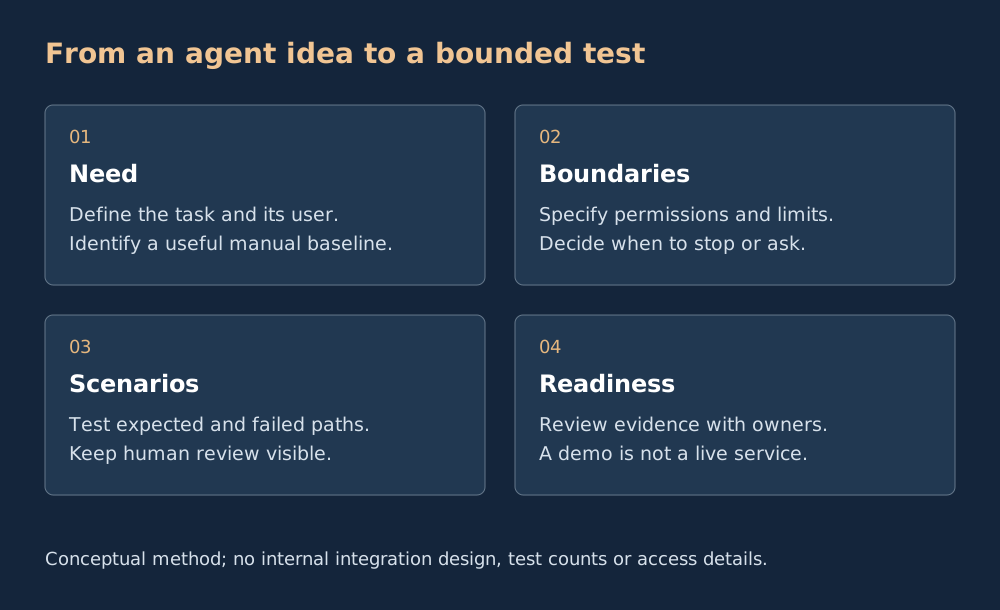
- DEFINEAgree the task, permitted inputs and acceptance criteria.
- TESTCheck useful behaviour, missing information and out-of-scope requests.
- REVIEWConsider privacy, reliability and support before wider use.
A CLOSER LOOK
Make the test boundary visible
EXPLAINABLE AI & DATA / READ THE METHOD
Read the evidence, understand the method.
A guide to the charts and case evidence on this page. Exhibit captions remain the authority for data origin and the claims each visual supports.
Follow the reasoning.
- SourceRead the exhibit’s evidence label
- RepresentInspect units, categories and scales
- CompareDistinguish observed results from demonstrations
- ReviewCheck limitations before taking action
Explore the building blocks.
Number of concepts in this guide, not performance or usage measures.
Explore the explanation matrix · 14 concepts
14 concepts shown
On small screens, scroll the table sideways. “Learning context” explains a related idea; it does not mean that method runs on this page. Deep learning is the standard term for “deep ML”.
| Technical term | Technical description / definition | In plain English | How this page uses it |
|---|---|---|---|
| Visual encodingVisualisation | Mapping values or categories to marks, position, length, colour and labels.Primary reference ↗ | Make the comparison visible, with a scale and a clear label. | Published analysis Read axis labels, denominators and captions before comparing exhibits. |
| Synthetic dataAI/Data Concepts | Generated records used to represent scenarios rather than directly report observed individuals or events.Primary reference ↗ | A practice dataset. Useful for demonstration, not proof of workplace impact. | Demonstration Exhibits labelled synthetic or reconstructed illustrate methods; they are not disclosed workplace records. |
| Descriptive analyticsAI/Data Concepts | Summaries of observed data using counts, rates, distributions or comparisons.Primary reference ↗ | Tell us what the records show; this alone does not predict next week. | Published analysis Counts and trend summaries describe the stated records and period, not future performance. |
| Residuals and prediction errorEvaluation & XAI | A residual compares an observed value with its fitted or predicted value. Error metrics summarise those discrepancies.Primary reference ↗ | How far did the estimate miss, and where does it miss most? | Learning context Prediction exhibits can compare observed and estimated values; a smooth chart alone is not validation. |
| Confusion matrix, precision and recallEvaluation & XAI | A confusion matrix counts predicted versus actual classes. Precision measures positive-result reliability; recall measures positive-case coverage.Primary reference ↗ | Which alarms were right, which were false, and which cases were missed? | Learning context Where a confusion chart is shown, inspect false alarms and missed cases as well as correct predictions. |
| Data science pipelineData Science Pipeline | An ordered, reproducible sequence for acquiring, validating, preparing, analysing and evaluating data.Primary reference ↗ | A chain from a question and source to an answer someone can check. | Published analysis Case studies connect the problem, evidence, preparation, method, evaluation and decision. |
| Explanation versus causal proofEvaluation & XAI | A model explanation describes selected behaviour or contributions; it does not establish causal effects or full reliability.Primary reference ↗ | A reason for this output is useful, but it is not proof that the model is right. | Responsible use A persuasive visual does not prove causation or transferability. |
| Data minimisationResponsible AI | Limit collected, disclosed and retained information to what is needed for the stated purpose.Primary reference ↗ | Use the smallest appropriate amount of information. | Responsible use Restricted source records stay private; approved aggregates and labelled reconstructions support public learning. |
| pandasPython Package | A Python library for labelled tabular data manipulation and analysis.Primary reference ↗ | A programmable workbench for cleaning and comparing tables. | Learning context A common Python option for tabular preparation; its inclusion is not a claim that this browser runs pandas. |
| MatplotlibPython Package | A Python plotting library for static, animated and interactive visualisations.Primary reference ↗ | Turn numerical work into labelled figures that can be inspected and shared. | Learning context A common way to prepare Python figures. This page displays published assets rather than launching Python plotting sessions. |
| Machine learning (ML)AI Capability | Methods that estimate patterns or parameters from examples to support inference on other inputs.Primary reference ↗ | Learn a pattern from examples, then check whether it helps with new ones. | Learning context ML learns from examples. Read the page-specific methods below to see whether any model runs here. |
| Deep learningAI Capability | Machine learning using neural networks with multiple representation-learning layers.Primary reference ↗ | A layered model learns useful representations; more layers do not guarantee a better answer. | Learning context Deep learning is an AI capability, not a label for every chart. No deep model is implied by this explanation panel. |
| Natural language processing (NLP)AI Capability | Computational methods for representing, analysing or generating human language.Primary reference ↗ | Help a computer work with words, while remembering that context matters. | Learning context Text search, translation, thematic classification and generation are different language tasks; their implementation is identified separately. |
| Sentiment analysisAI Capability | A language-analysis task that estimates an expressed attitude, often as polarity or sentiment categories.Primary reference ↗ | Estimate the tone of words—not the private feelings or personality of their author. | Learning context Sentiment estimates expressed tone. It must not be confused with topic classification or a diagnosis of a person. |
No matching concepts. Choose another category or clear the search.