← Family chronicle

TAPESTRIES / ÌDÍLÉ / OLÓTÁ

Olótá and the houses he joined.

Sisebola Itiolaye Olótá, born circa 1780 in the family record, is the earliest named forebear in this branch of my family account. In his 4 May 2023 presentation of the Oró palace account, my father describes how his horseback journeys connected Ilé Olúkòtún with the royal houses of Èdídí (Èlédídí) and Oró (Bàálè).

Words in context: Ilé — home or family houseBàálè — local rulerỌmọọba — prince or princess More Yorùbá terms ↗

A name from his mother’s home

The Oró palace account identifies Sisebola Itiolaye by the title he preferred: Olótá. In its account, his mother came from Ìlótá, near Ìlọrin, and the ruler there bestowed the title on him. The place and name matter because they locate one more relationship within the wider Yorùbá world; the date and circumstances of the conferment still need a shareable record.

The account portrays him as prosperous and influential, with a large household. Family versions differ on the number of wives; no household register is presented here. What interests me most is the energy behind the relationships he cultivated. He sounds larger than life; I often wish I could have sat with him and heard his account in his own words.

THOMAS OLOTA / A LIVING CONNECTION

A face within reach of memory.

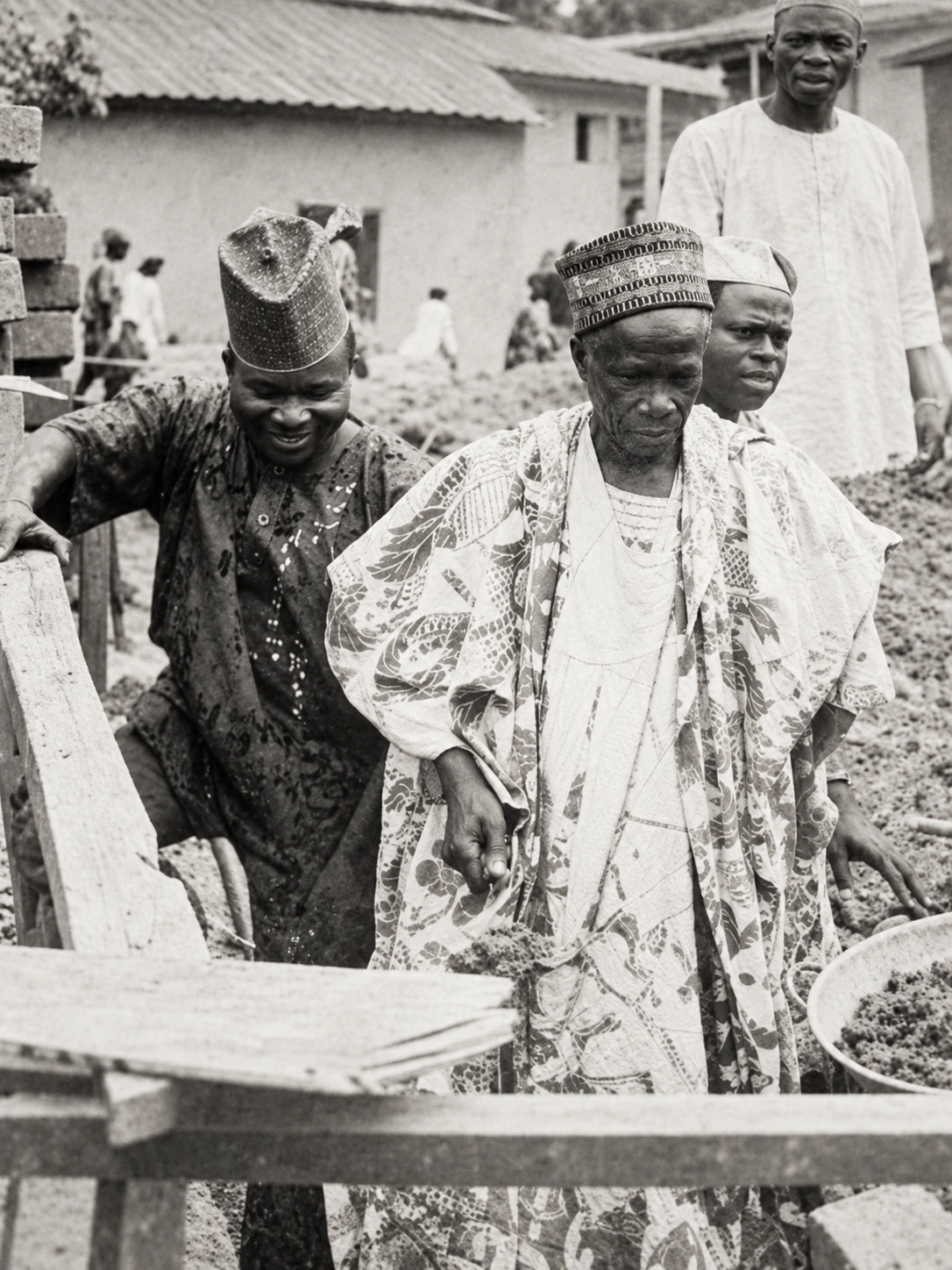
AI-assisted restoration of the family photograph identifying Olota Thomas near the centre in flowing agbádá, with Chief Olatunji Raphael Ibiwoye and others at a building foundation occasion in Oró
Olota Thomas at Oró · circa 1987–1988. The family identifies him as the elderly man near the centre in flowing agbádá. The occasion is remembered as marking out and laying the first foundations of a building.
Restoration & original photograph

AI-assisted restoration for viewing; fine details may be reconstructed. Faces and expressions should be compared with the original, which remains the historical reference.

View untouched original ↗

This photograph brings a name from our family history into the company of people my father knew. Our family identifies the central figure as Olota Thomas, the youngest son of Sisebola Itiolaye Olótá and younger brother of Oyelónnù. In that family line, Thomas was my father’s grand-uncle.

My father and the others gather around him as a building begins to take shape in Oró. I read excitement and affection in my father’s face. The occasion has practical work at its centre—marking the ground, setting foundations—but for me it also holds the pleasure of being together across generations.

I have often wished I could have met the larger-than-life Olótá himself. Seeing his youngest son feels like the closest visual connection our family archive offers to that wish: a person, a presence and a moment within reach of living memory. It cannot tell us what Olótá looked like, but it makes the relationship feel less remote.

“The past is never dead. It’s not even past.”

William Faulkner, Requiem for a Nun ↗
Family account & historical context

The identification, kinship and building occasion follow our family recollection. The family dates the photograph to around 1987–1988; the building’s identity is unrecorded here.

A 29 September 2017 report in The Sun and an 8 January 2018 profile in City People describe Dr Gabriel Bamidele Olanrewaju Olota as Oró’s first medical doctor. One possibility is that Olota Thomas was his father. This proposed relationship remains unverified; the reports do not establish Gabriel’s parentage or identify Thomas in this photograph. It is preserved here as a research question, not a confirmed genealogy. Family testimony supported by birth, baptismal, obituary or other biographical records could help establish the connection.

See Thomas alongside the wider family archive →

THE JOURNEYS

On horseback between palaces.

My father, Chief Olatunji Raphael Ibiwoye, set out the Oró palace account in a family post dated 4 May 2023. It places Olótá first riding from Kàá Balógun, Ilé Olúkòtún in Oró to the court of the Ẹlẹ́dídí. Many years later, Olótá rode to his close friend Bàálè Abioye of Oró. Both visits sought lasting ties between households through marriage.

TWO HOUSES / ONE DESCENDANT LINE

How the relationships meet.

This is the palace account of kinship as conveyed by my father. The intervening dates and records remain open to further research.

01 / ÈDÍDÍ

Oyelónnù and Ọmọọba Maria Salome Oníkòyí

Olótá asked the Ẹlẹ́dídí for the hand of his daughter, Ọmọọba Maria Salome Oníkòyí, for his firstborn son Oyelónnù (Òyelóhúnnú Ọlóta in the family-tree entry, born circa 1830). The palace-record summary places her father on Èdídí’s throne around 1852. It names Ìyá Ìlúdùn, Pàá Abdul Salami and Ìbíwoyè Jacob Kánímọ́lé, my paternal grandfather, among their children. Through Kánímọ́lé’s mother, our branch carries a connection to Èdídí’s royal house.

02 / ORÓ & Ọ̀YỌ́

Kánímọ́lé and Ọmọọba Moróláké Agnes

In this Oró palace account, Baálẹ̀ means king or traditional monarch: Abioye, Atóyèbí and Afolayan are remembered as royal titleholders within the family’s dynastic tradition. The older title carries a history of lineage, stewardship and duty. Read about the title and the Ìbàdàn comparison ↗

Olótá later visited his friend Bàálè Abioye (Abíòyè in the family-tree entry), father of Bàálè Atóyèbí of Oró, to propose a future marriage between their grandchildren. In the account, Abioye’s first granddaughter Ọmọọba Moróláké Agnes was still a toddler when the families agreed. The palace account says Abioye later sent her to the palace of his friend Emir Abdul Kadri of Ìlọrin, whom he called Baba Agba. She returned to Oró as a young adult and married Ìbíwoyè Jacob Kánímọ́lé. The proposal belongs to the custom of its time; the account places their marriage in adulthood. Ọmọọba Moróláké Agnes was my paternal grandmother, and the palace genealogy traces all Bàálè lines, including hers and therefore mine, to Ọmọọba Òlákànmí of Ọ̀yọ́, whose migration it places in the 1460s CE.

These marriages bring the Ilé Olúkòtún, Èdídí and Bàálè Oró strands together in one family line. The Ọ̀yọ́-Ilé essay explains how my father relates the Bàálè house to Ọ̀yọ́, while recognising that the generations between Òlákànmí and later named relatives need clear public archival citations.

Kánímọ́lé, a force in his own day.

The family tree records my grandfather as Ìbíwoyè Jacob Kánímọ́lé (c. 1887–1977). It remembers a young man with no formal schooling who left Oró for Èkó at about seventeen and became a clothing trader in Ìdúmọ̀tá. In family memory, he was among the prosperous and influential people of his generation. My father’s notes say Kánímọ́lé was invited to take the Olúkòtún title in the early 1970s; he declined and supported Sanni Tákìtì I, Olúkòtún of Oró, whose installation relatives witnessed at Ọ̀kérímì. His grandson, Babatunde Sanni Tákìtì II, currently holds the title of Olúkòtún of Oró.

Yorùbá presence at Greenwich →

The family timeline credits him with a pioneering storeyed house and corrugated roofing in the Ìlọrin region, and recalls an Emir of Ìlọrin lodging at his home during a visit. The timing of these achievements is still being researched. Property records, palace material, photographs and other local testimony may help establish when they occurred and which Emir visited.

The family-tree timeline gives 3 October 1887 at Oró for birth (treated as approximate) and 1 October 1977 in Èkó (Lagos) for death. The dates of his trading, building work and royal visitor need separate corroboration. Establishing their sequence would reveal more about when Oró’s built and commercial life changed.

More than a list of ancestors

My father shared this account while welcoming his granddaughter to the family, a child I named Moróláké after my paternal grandmother Ọmọọba Moróláké Agnes. My firstborn daughter thus carries her name into another generation.

I am proud to be Olótá’s great-great-grandson. My line runs through his firstborn son Oyelónnù and then through Ìbíwoyè Jacob Kánímọ́lé, my grandfather. The family timeline portrays Kánímọ́lé as a prosperous trader and an influential figure in his own time. Olótá’s descendants are many across Oró and wider Yorùbáland; this is one branch of a much larger family, not a claim that his story belongs to mine alone.

Read moreRead less

Olótá’s story asks what it meant to sustain friendships and obligations between households. The royal connections are part of my identity, but I share them to understand people and places, and to invite younger relatives to ask what our forebears did with the relationships they inherited. My father knew Olótá through the palace record, never as a living acquaintance, and has always spoken of him with affection and awe. I share both feelings. I wish we could have met him and heard the story in his own words.

The family chronicle carries my father’s voice; the two oríkì strands and family photographs preserve other forms of memory. I would like future work to place the palace accounts, dates and name variants beside records that can be cited publicly, while leaving room for other families’ perspectives. Every date we can anchor gives a person and place a clearer setting; every unresolved date points to the next archive, elder or object to consult.

Source note: The sequence, household relationships and Ìlọrin palace episode follow the Oró palace account conveyed by Chief Olatunji Raphael Ibiwoye in his dated 4 May 2023 post, edited here alongside family genealogy and later clarification. His account calls Olótá’s first son Oyelónnù and uses both Ìbíwoyè Popoola (at the proposal) and Ìbíwoyè Jacob Kánímọ́lé (at the marriage); the latest family-tree entry supplied for this page includes Popoola among Kánímọ́lé’s names. A family-supplied palace-record summary identifies her as Ọmọọba Maria Salome Oníkòyí and places her father’s reign around 1852; a later family clarification uses the spelling Oyelohunnu. The birth estimate of circa 1780 and the title origin follow family records and recollection. The approximate life dates do not independently establish the chronology of the journeys or marriage arrangements. See the family-date record → Accounts vary on the number of Olótá’s wives, so no count is asserted here. The events themselves have no verified calendar years here.

Historical reading · Akintoye & Ogundiran

For the wider Yorùbá historical setting. The family accounts and episode traditions on this page retain their own named sources.

OSL · Olukotun Studios Ltd

Olukotun Studios Ltd · Registered in England and Wales · No. 17537910

LinkedIn ↗