TAPESTRIES / ROOTS & IDENTITY
A passport to Yorùbá identity.
This contemporary document, labelled a Yorùbá diplomatic passport, expresses an identity rooted in centuries of language, art, places and institutions — an inheritance that long predates today’s political arrangements.
Words in context: Yorùbáland — the cultural homeland of Yorùbá peopleoríkì — praise poetry and praise names More Yorùbá terms ↗
A PERSONAL MOMENT / 2026
What I saw when I held it.
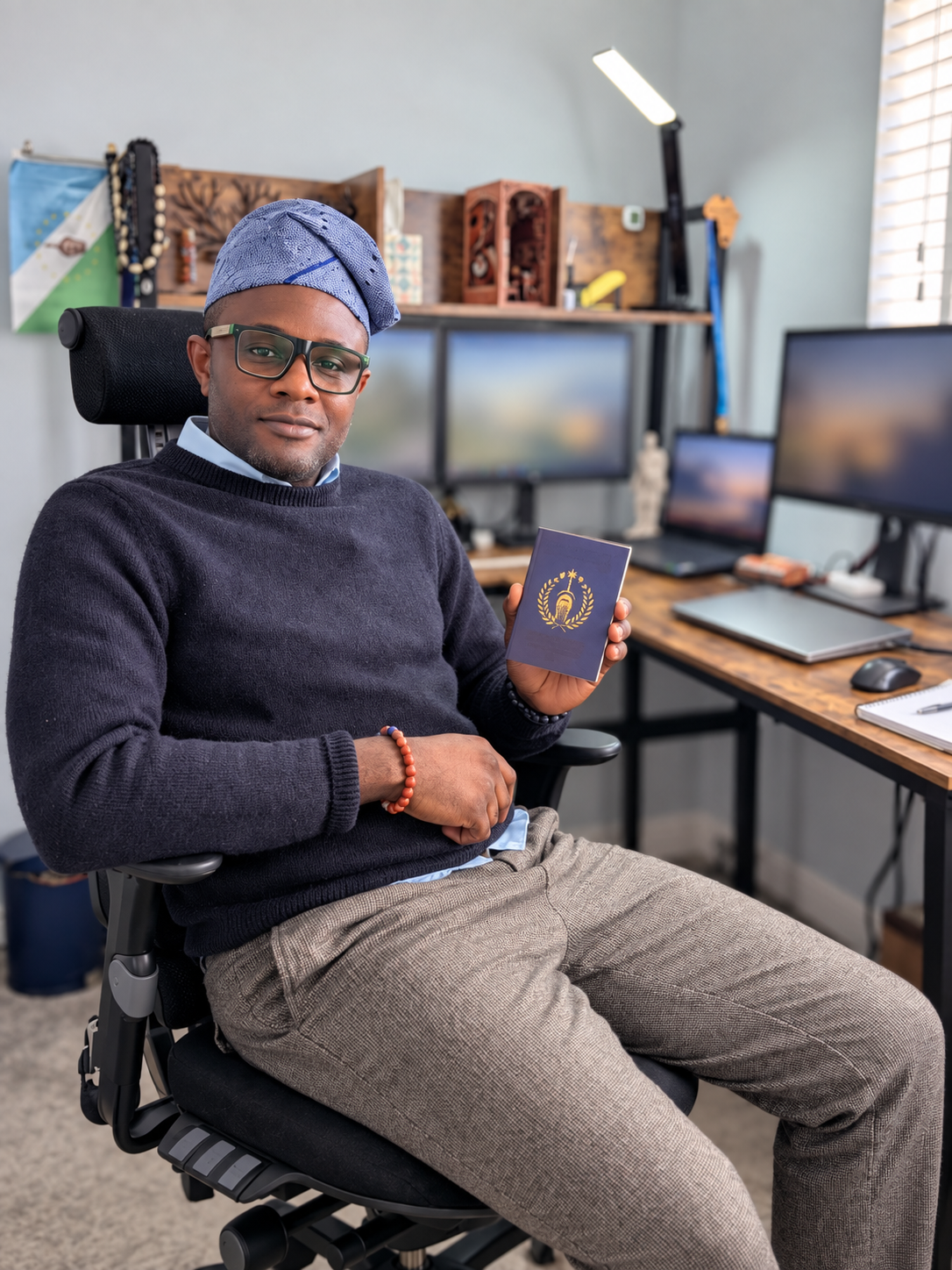
I have more than one way of locating home. Oró is where the family story opens for me; Ọ̀bà-Ilé carries an ancestral thread; Ilé-Ifẹ̀ speaks to a wider Yorùbá inheritance. Holding this cultural identity document drew those scales together. For me, the moment in 2026 marked a milestone: a public affirmation of the identity I inherited, have studied and choose to carry forward.
My gratitude in the original photograph is directed to Professor Ádébánjí Akíntóyè and others whose public leadership helped give this conversation visibility. The object matters to me as an expression of cultural identity and collective imagination. It invites a serious conversation about who we are, what earlier generations built and what we can build together now.
That is the spirit in which I share the image: with pride, and with room for other Yorùbá people to tell their own stories of belonging.
Read the words from the portrait ↓THE OBJECT / WHAT IS VISIBLE
A contemporary cover, an enduring inheritance.
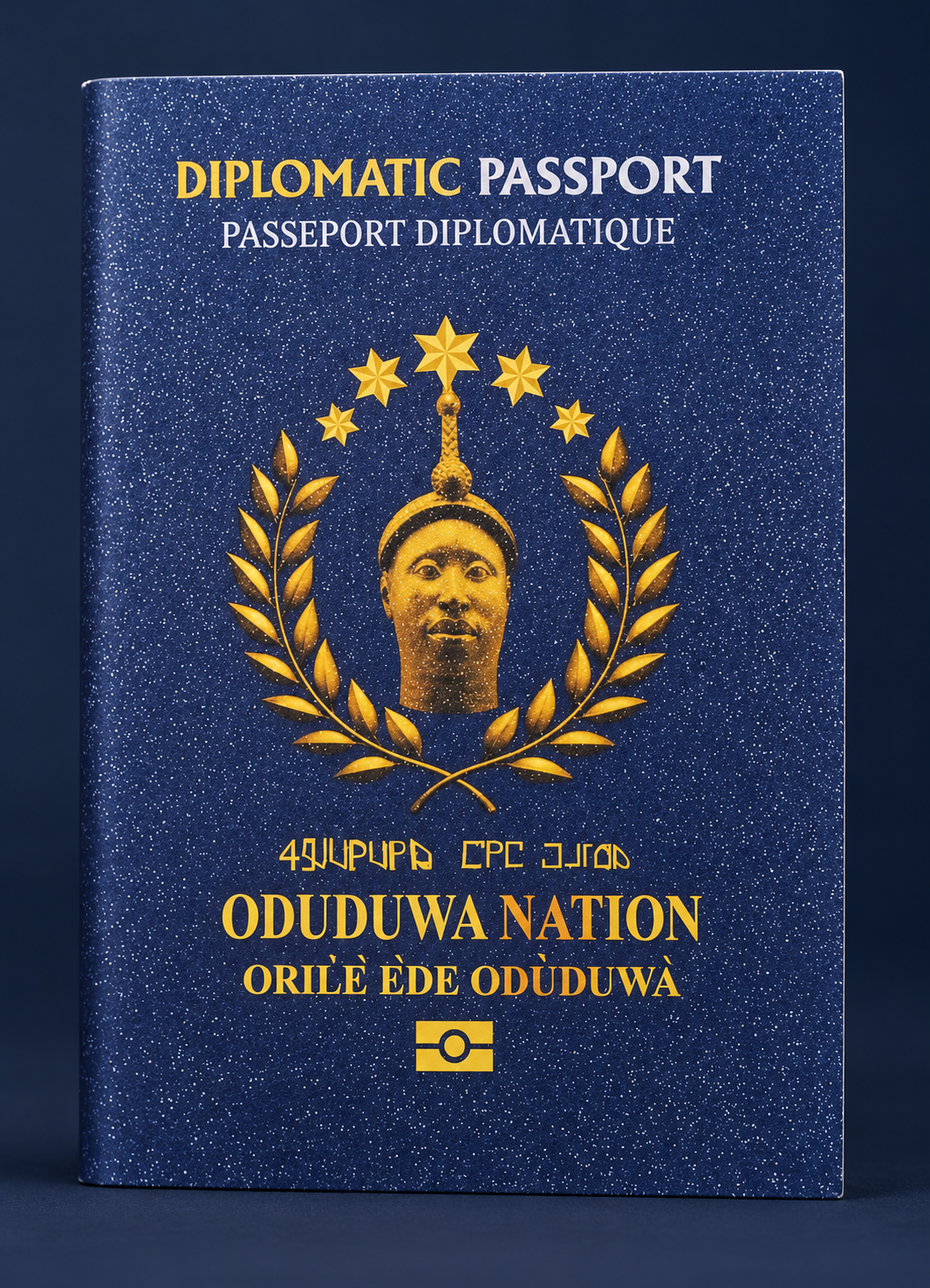
The diplomatic passport in the supplied photograph bears “Diplomatic Passport” and its French counterpart, along with “Oduduwa Nation” and a Yorùbá line beneath. On a blue field, a gold-toned sculpted head sits between branches below an arc of five stars. A small geometric mark appears near the foot of the cover.
Odùduwà is a foundational figure in Yorùbá traditions of origin and kingship; the image naturally sends me back to the artistry and memory of Ilé-Ifẹ̀. The stars, branches and colours invite reflection on dignity, continuity and aspiration. The identity they evoke is older and more expansive than any present political map. I do not have an authenticated design key from the maker, so I will not assign each mark a fixed official meaning or identify the pictured sculpture as a particular historical person.
The cleaned image presents the cover on its own, away from the patterned background in the original snapshot. It is an edited visual derived from the supplied photo, not a document facsimile or evidence of official status, diplomatic privileges or validity for travel.
THE WORDS / OUTSIDE THE IMAGE
Clarity of identity.
The original portrait carried these sentiments across its lower half. They are set here as text, lightly edited for readability, so the photograph can breathe and the message can be read.
“One’s Yorùbá Nation Diplomatic Passport. Grateful to Professor Ádébánjí Akíntóyè and the wider global movement for their leadership and commitment. A proud moment — one that affirms an enduring heritage and brings renewed clarity of identity.”
“A ó dé Ilẹ̀ Ilérí — orílẹ̀-èdè Yorùbá olómìnira.”
A milestone in affirming identity
A people can begin with their own names. We can teach younger generations how to pronounce them; record oríkì with their contexts; compare family memory with scholarship; connect communities at home and abroad; and tell stories on screen that do justice to their sources. Tapestries of Yorùbá Civilization is one way I am doing that work.
The diplomatic passport gives a contemporary form to an inheritance shaped across generations. For me, it is a milestone in naming that inheritance openly. Belonging grows stronger through patient research, language, public service and institutions that people can trust. The smallest acts — asking an elder, checking a place name, translating with care, making knowledge accessible — accumulate. This is the kind of confidence I hope other Yorùbá people, especially the young, take from the image.
Cultural identity and public interpretation
I present this object as a personal expression of cultural identity. This page does not establish it as a recognised travel document or a source of diplomatic status, immunity or entry rights, and makes no recommendation to use it for travel.
The Unrepresented Nations and Peoples Organization (UNPO) is an independent international organization founded in 1991 to bring unrepresented peoples into wider dialogue and advocacy.
Source and image note: This account draws on my supplied 2026 photographs and private working notes. The source portrait’s text is reproduced above in an edited form. Both displayed images are visual edits of the supplied photographs, not documentary scans of the diplomatic passport. The personal interpretation is mine.
Historical reading · Akintoye & Ogundiran
For the wider Yorùbá historical setting. The family accounts and episode traditions on this page retain their own named sources.
- S. Adebanji Akintoye · A History of the Yoruba PeopleAmalion, 2010 · A broad historical account of Yorùbá societies and kingdoms.
- Akinwumi Ogundiran · The Yorùbá: A New HistoryIndiana University Press, 2020 · Archaeology, oral traditions and historical change.