Oòni of Ilé-Ifẹ̀
Ọba Adeyeye Enitan Ogunwusi, Ojaja II
Reign began: 2015. Coronation: 7 December 2015. Date source ↗
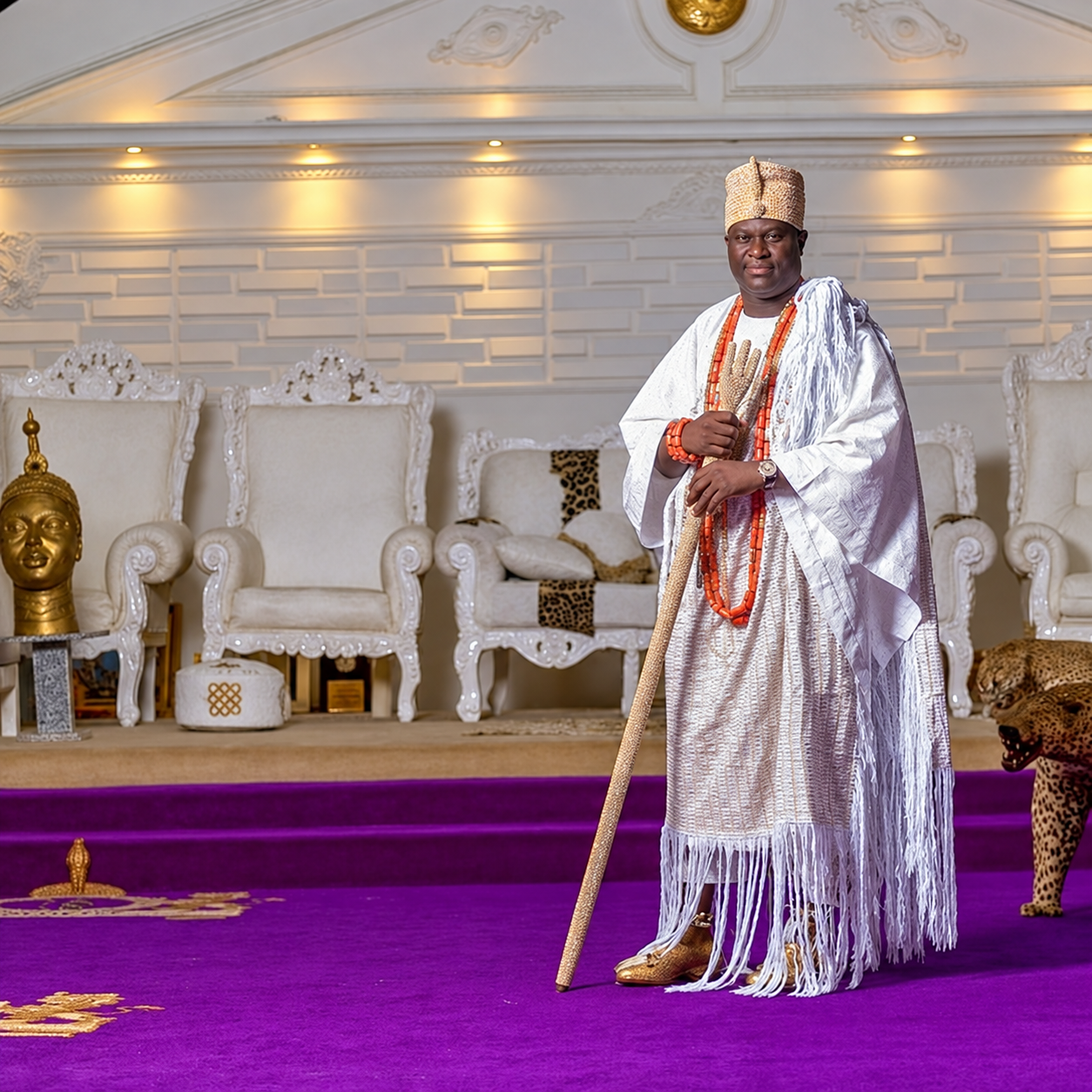
Standing in white regalia with a ceremonial staff: a portrait of the living institution explored in this chapter. Read further.
Context-aware translation drafts. Original English remains available.
Russian celebrates Daria and Adémidé’s family heritage; Igbo celebrates Lékan’s maternal roots.
Translation notes & sourcesSuggest a correction ↗ORÍSUN / ILÉ-IFẸ̀
Ilé-Ifẹ̀ holds a foundational place in Yorùbá thought. Its traditions of origin, its Oòni, and its extraordinary sculptural legacy speak to a civilization with its own political imagination and artistic mastery.
Words in context: Oòni — title of Ilé-Ifẹ̀’s rulerỌba — ruler or monarchorísun — source or origin More Yorùbá terms ↗
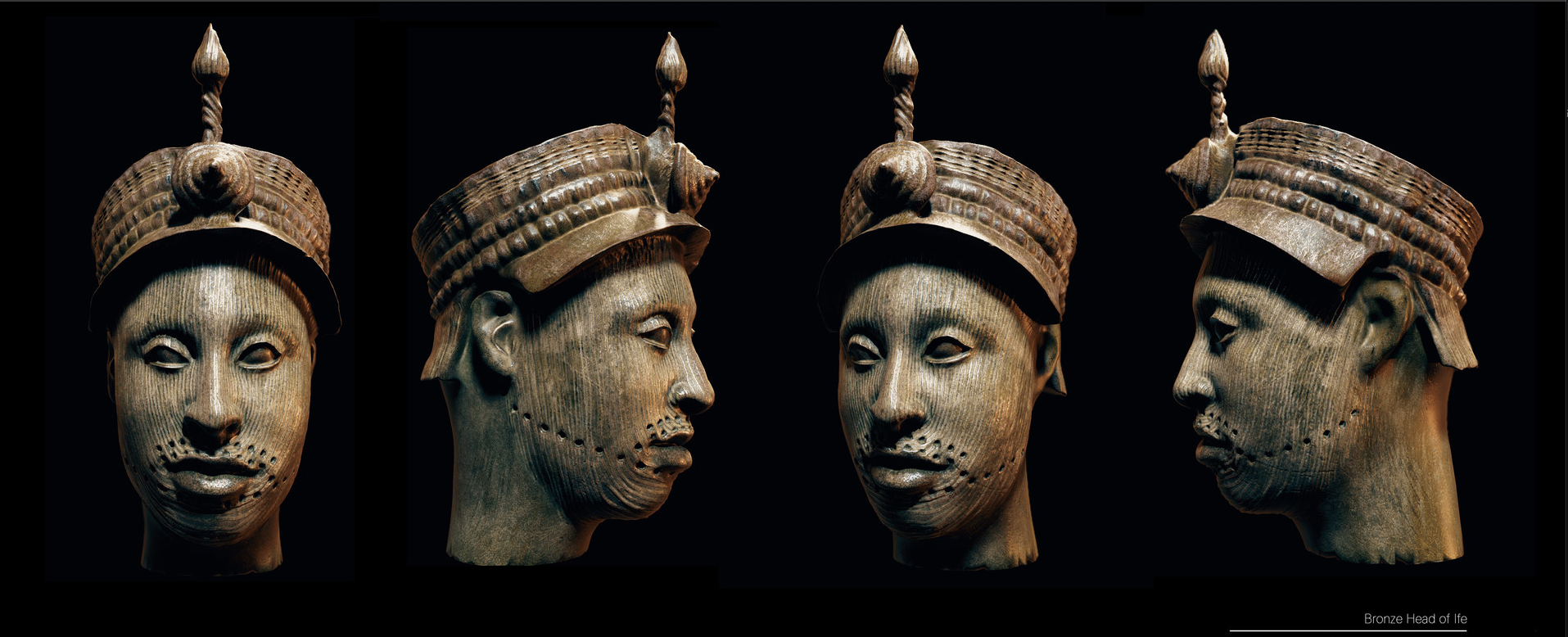 WATCH THE FILM ↓
Four views reveal the head’s overall form, crown and fine surface details—an introduction to the sculptural tradition of Ilé-Ifẹ̀ in Yorùbáland. This contextual cover opens The British Museum’s film below; it is not a still from the film.
Oòni of Ilé-Ifẹ̀
Reign began: 2015. Coronation: 7 December 2015. Date source ↗
Standing in white regalia with a ceremonial staff: a portrait of the living institution explored in this chapter. Read further.
EXTERNAL FILM / THE BRITISH MUSEUM
Watch here, or open the film on YouTube. If the player is unavailable in your browser, the direct link and address below provide another way in.
Open directly on YouTube ↗Video address: youtube.com/watch?v=JNmCg3nNi1U
01 / THE ORIGIN
In Yorùbá sacred accounts, Ilé-Ifẹ̀ is a place of beginnings. Odùduwà appears both in creation traditions and as the ancestral figure through whom royal authority is narrated. Ọbàtálá also has a central place in these accounts. The narratives carry religious, ethical and political meanings; different communities preserve different tellings.
To speak of Odùduwà’s descendants is therefore to speak of kinship, remembered migration and the right to rule, as well as genealogy. “Child” or “descendant” can name a dynastic relationship across generations, rather than a complete list of literal children in one lifetime.
PLACE / MEMORY / LANDSCAPE
These two works by Oramfe bring different kinds of context to Ilé-Ifẹ̀: a modern map interpreting earlier communities, and a photograph of a hill in today’s landscape. Read them alongside the historical and archaeological sources in this chapter.
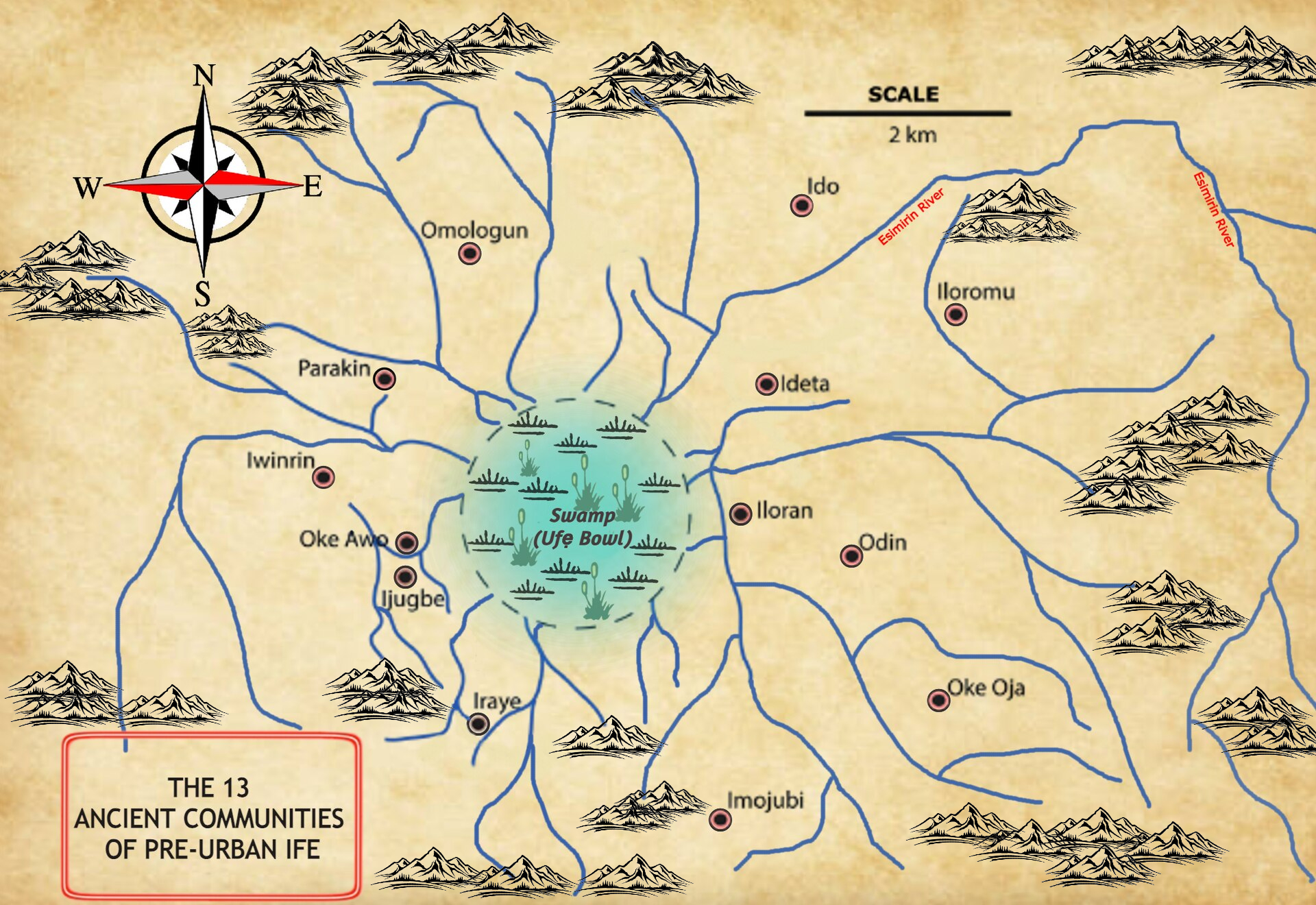
Oramfe’s map places thirteen named communities around the Ifẹ̀ bowl. Read it as an interpretation of estimated relative locations, not surveyed archaeological coordinates or a dated record of unification.
By Oramfe · 2023 · Source on Wikimedia Commons ↗ · CC0 1.0
Original image reproduced without alteration. Select the image to view it at full size.
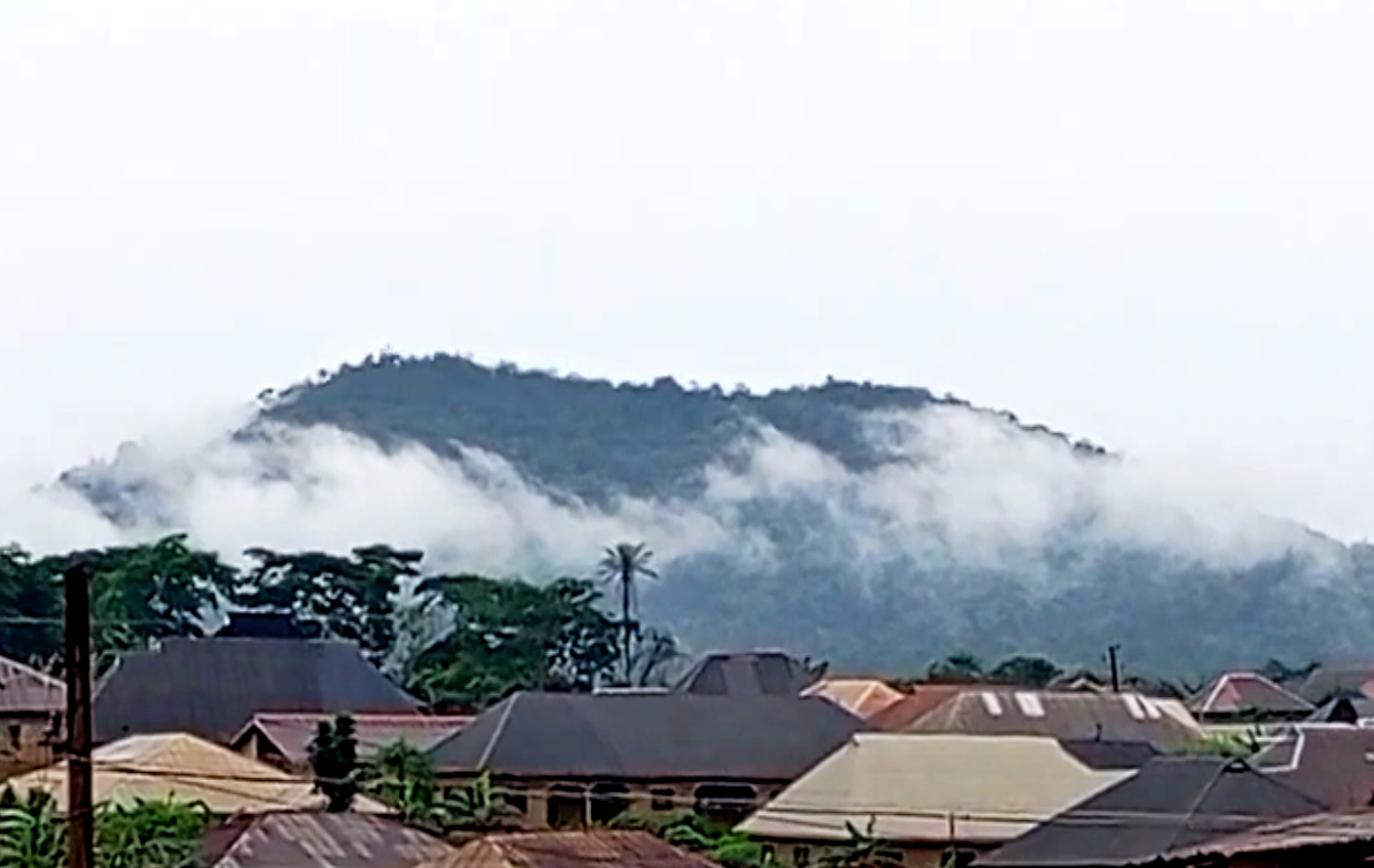
A present-day view of Ora Hill beyond the town’s rooftops. The photograph gives the landscape a tangible presence; it does not establish the route or date of an ancient migration.
By Oramfe · 2024 · Source on Wikimedia Commons ↗ · CC BY 4.0
Original image reproduced without alteration. Select the image to view it at full size.
02 / THE CROWN
The Oòni is the traditional ruler of Ilé-Ifẹ̀ and custodian of a seat of profound religious and dynastic importance. Royal beaded crowns, court ritual and claims of descent link Ifẹ̀ to other Yorùbá monarchies. The title continues to connect a living city with a much older network of authority.
The history is larger than a single court. Ifẹ̀’s communities, makers, shrines and scholars each hold part of the record. Its centrality is best understood through those relationships and the varied voices that sustain them.
03 / THE KINGDOMS
A tradition speaks of sixteen original kingdoms or princely lines radiating from Ifẹ̀ through Odùduwà’s descendants and followers. The number is a powerful expression of a shared political ancestry. Traditions from Ọ̀yọ́, Ìjẹ̀bú, Òwò and the Benin court, among others, tell their own versions of an Ifẹ̀ connection.
There is no single settled list that turns every foundation story into one dated event. Historical research shows that different states formed across centuries, through local communities, movement, alliance and conflict. The sixteen-crown account is valuable as inherited political memory; each kingdom also deserves its own history.
04 / THE ART
Between roughly the twelfth and fifteenth centuries, Ifẹ̀ flourished as a centre of remarkable terracotta and metal sculpture. The Met dates a broad corpus of Ifẹ̀ terracottas to approximately 1000–1400 CE; individual objects have their own date ranges. The heads and figures reveal technical command and a varied aesthetic language extending beyond royal patrons. Their existence challenged old European claims that such art could not have been made in Africa.
See each photograph on its own. Follow the object record to distinguish a catalogued attribution from an identification still open to research.
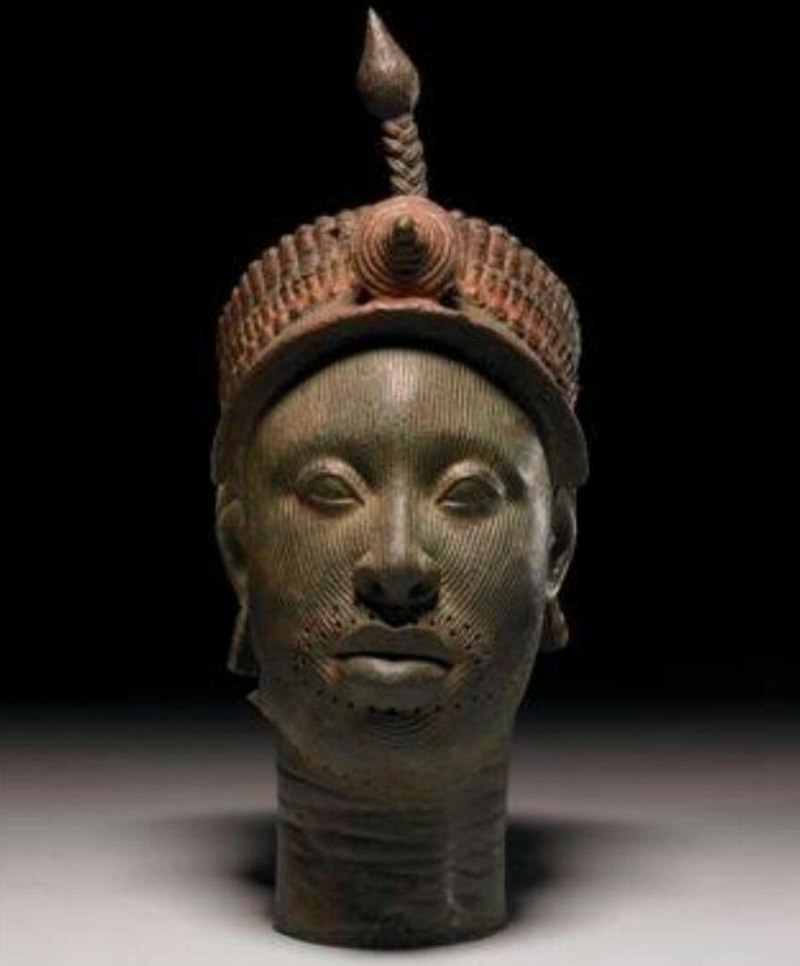
The composed mouth, steady gaze and elaborate crown invite a reading of authority held with assurance. The museum identifies a probable ruler; a particular monarch’s name is not established. This is the Ifẹ̀ head—not a verified portrait of Odùduwà.
Explore the full collection →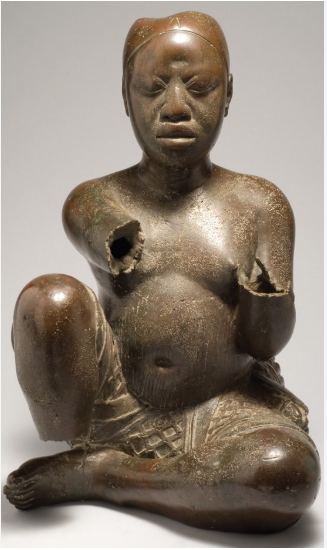
The seated body makes physical presence its subject. Found at Tada beside the Niger, and attributed to Ifẹ̀, it connects sculptural skill with river routes and ritual life. Its surviving form commands attention without requiring us to invent the sitter’s name.
NCMM, Nigeria · 79.R18
Catalogue photography: Karin L. Willis / Museum for African Art and Fundación Marcelino Botín.
Source & context ↗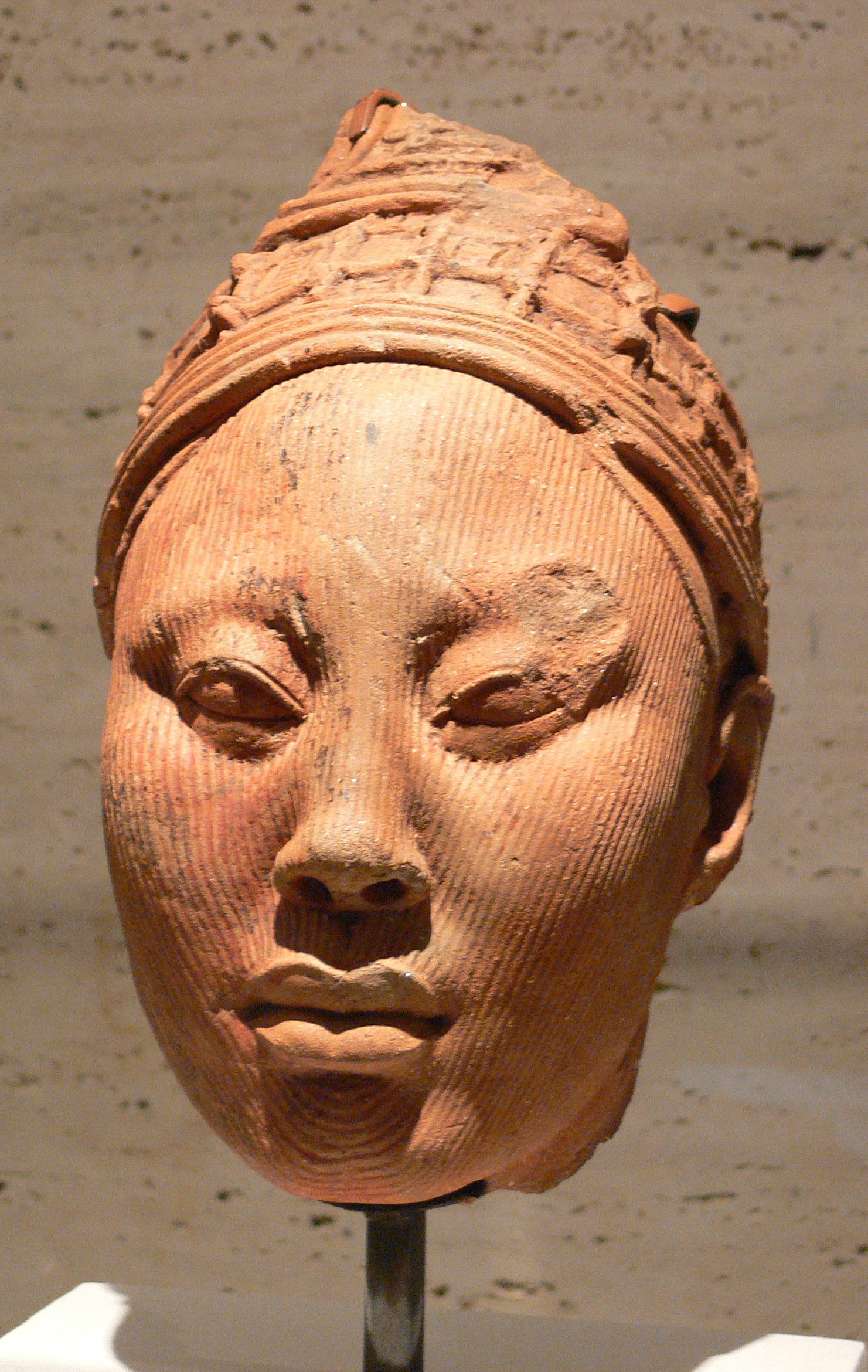
A fine network of lines follows the face beneath an intricate crown. The title “Head, possibly a King” preserves an important uncertainty. The quiet expression and exact modelling reward slow looking: royal dignity is suggested, rather than shouted.
Kimbell Art Museum, Fort Worth · AP 1994.04
Photograph: FA2010, public domain.
Source & context ↗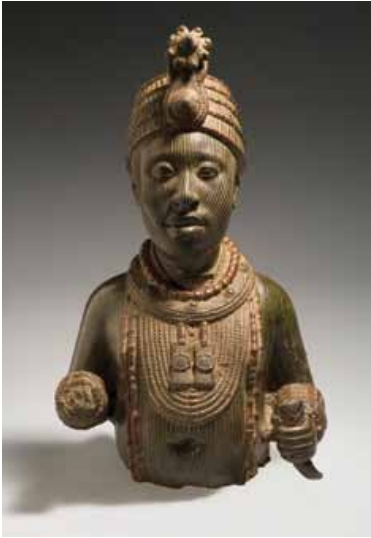
Layered beads, a rosette-topped crown and poised hands give this surviving upper body its ceremonial presence. It is catalogued as a king; neither the photograph nor the record securely identifies a particular ruler.
National Museums, Èkó (Lagos) · 38.1.1, as catalogued in 2012
Blier (2012), figure 10 · catalogue photography: Karin Willis / NCMM and Museum for African Art.
Source & context ↗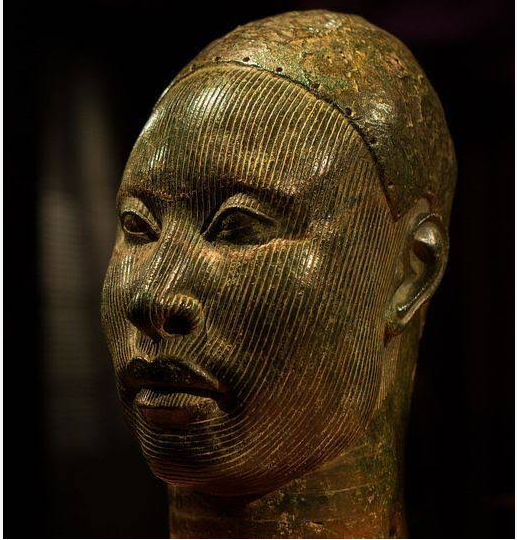
Fine facial lines turn across cheeks and brow, while the surviving surface records age and damage. The image corresponds to the striated head illustrated in Blier’s study. We can admire the maker’s precision without claiming to know the subject’s thoughts.
National Museums, Ifẹ̀ · head no. 6 in Blier, figure 20
Catalogue reference: Blier (2012), figure 20.
Source & context ↗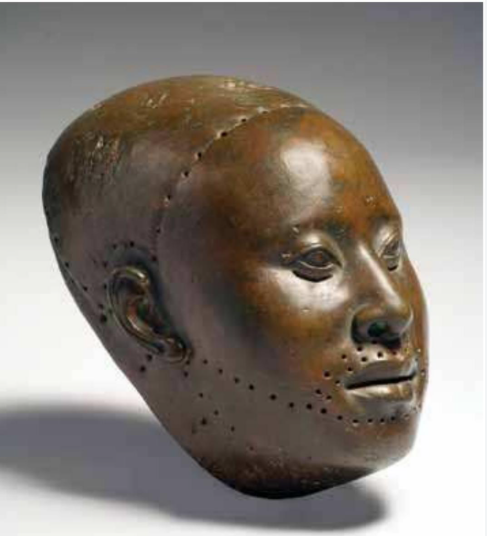
Smooth cheeks, carefully formed lips and small attachment holes give this head its distinctive presence.
Collection and accession number not yet confirmed
Source & context ↗In 1938, a brass head now in the British Museum's collection was found at Wunmonije Compound in Ifẹ̀. That is a modern discovery date, not the date of the sculpture or of Odùduwà. The film above, Kingdom of Ife: Ife uncovered, is presented by The British Museum. The contextual cover shows four views of an Ifẹ̀ head; it is not offered as a catalogue identification of that specific museum object.
These works open a wider story: the people who made and used them, the importance of Ilé-Ifẹ̀ to Yorùbáland, and the enduring responsibility to interpret cultural objects with originating communities in view. Read The Met's art-historical account ↗
READ FURTHER
This introduction distinguishes sacred and dynastic traditions from archaeological and historical dating. The linked film is a perspective for exploration; the sources below support the historical framing. Professor Akinwumi Ogundiran’s LinkedIn profile offers a professional introduction alongside his publications.
ANOTHER HISTORICAL LENS
O. B. Lawuyi’s The Obatala Factor in Yoruba History examines Ọbàtálá narratives as ways of thinking about political change, peace and leadership. He recognizes the difficulty of dating an encounter with Odùduwà from oral traditions. His essay offers an interpretive argument, rather than an independently dated account of a takeover.
Lawuyi asks why Ọbàtálá’s significance persists when Odùduwà becomes central to dynastic accounts. His discussion allows the history of leadership to include reconciliation and moral authority as well as conquest. For Tapestries, the question is how to represent different memories without making one dramatic scene stand in for settled history.
Read this alongside the Akintoye and Ogundiran works in this page’s reading list. Lawuyi (1992), History in Africa 19, 369–375.

Explore the relationship between art and architecture · Poetry and philosophical interpretation.
Archaeology can help date material and settlement; oral and dynastic traditions preserve accounts of origin, authority and belonging. Neither alone settles every detail of an event. Ask who produced an account, when it was recorded, what context survives and which independent sources support the claim.
A reconstruction is an interpretation, not a photograph of the past. Read Akintoye and Ogundiran alongside the sources listed above, and keep uncertainty visible.
YORÙBÁLAND / DEVELOPMENT
Follow evidence about art, glass, craft and urban life into modern education, research and responsible production. Historical achievement informs questions; feasibility still needs present-day testing.
Explore the development hub → · Open both interactive maps → · Sources and review · A civilization’s next chapter. →
ILÉ-IFẸ̀ / A CITY IN SONG
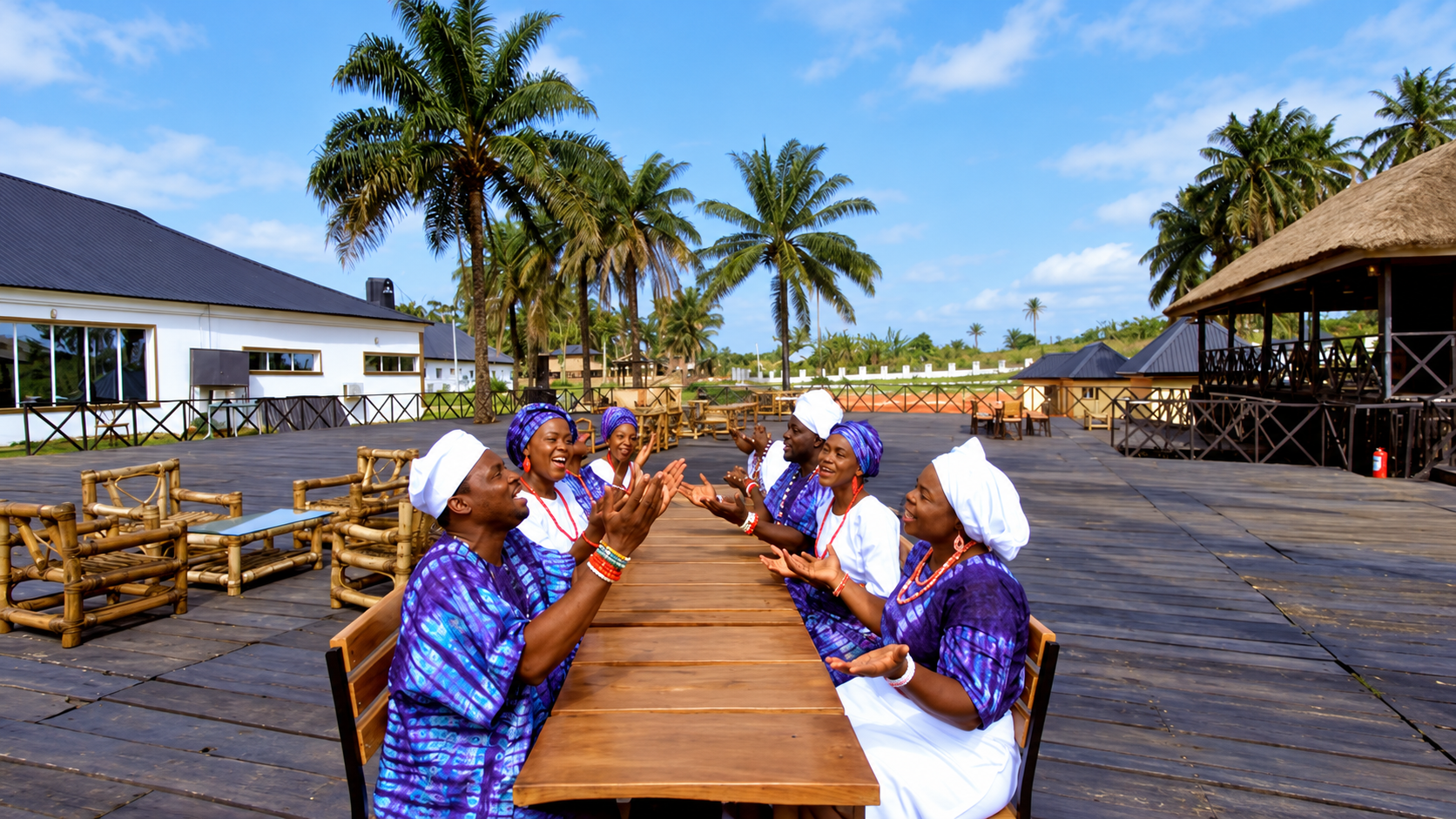
A city is carried in voices as well as objects and places. This performance by Team Definition brings the Ilé-Ifẹ̀ anthem into the chapter alongside its art, landscape and traditions of origin.
Thumbnail: AI-cleaned from the supplied Team Definition video screenshot; player text and controls removed. Performance and video credit: Team Definition.
Performance: Team Definition · Watch the original video ↗
The Oòni’s website publishes an Ilé-Ifẹ̀ anthem honouring the city’s sacred origins and calling for pride in, and care for, the community. Its references to Ọ̀rúnmìlà and Odùduwà belong to a sacred account of origin. This description summarises that published text; it does not treat sacred tradition as an archaeological finding.
Read the published Yorùbá lyrics on the Oòni’s website ↗
The published text has not been established as an exact transcript of Team Definition’s performance. No authoritative English translation of this recording or open licence for full lyric reproduction has been verified. The English description above explains the published text’s themes.
The Odùduwà flag and Yorùbá nation anthem → · Explore the sculpture and sacred-art collection →
These learning tools expose selected representations and comparisons. They cannot authenticate a tradition, infer ancestry or replace language speakers and cultural custodians.
Number of concepts in this guide, not performance or usage measures.
9 concepts shown
On small screens, scroll the table sideways. “Learning context” explains a related idea; it does not mean that method runs on this page. Deep learning is the standard term for “deep ML”.
| Technical term | Technical description / definition | In plain English | How this page uses it |
|---|---|---|---|
| Unicode normalisationAlgorithm | Transforming equivalent character sequences into a consistent Unicode representation.Primary reference ↗ | Help differently encoded letters match without throwing away meaningful accents. | Method guide Tone and underdot preservation matter when representing Yorùbá text; spelling differences may carry meaning. |
| Natural language processing (NLP)AI Capability | Computational methods for representing, analysing or generating human language.Primary reference ↗ | Help a computer work with words, while remembering that context matters. | Learning context Language technology needs context and evaluation by speakers, especially for underrepresented varieties. |
| Word error rate (WER)Evaluation & XAI | Substitutions, deletions and insertions divided by the reference word count.Primary reference ↗ | Compare a transcript against a checked reference; the number alone cannot judge cultural meaning. | Learning context Where transcription comparisons appear, word-level errors are only one quality signal; tone and meaning need review. |
| Rule-based logicAlgorithm | Explicit authored conditions map inputs to outputs without fitting parameters from training examples.Primary reference ↗ | A transparent set of if-this-then-that instructions. | Running here The retained learning activities use authored examples and deterministic choices, not divination, identity prediction or generated historical evidence. |
| Visual encodingVisualisation | Mapping values or categories to marks, position, length, colour and labels.Primary reference ↗ | Make the comparison visible, with a scale and a clear label. | Published analysis Diagrams encode the stated categories or relationships; visual resemblance does not establish historical or scientific equivalence. |
| Coverage, bias and representationResponsible AI | Assess how sampling, labels, missing groups and design choices affect error and applicability.Primary reference ↗ | Ask whose experience the data includes—and whose it misses. | Responsible use Missing language varieties and permissions can make a seemingly polished dataset unrepresentative. |
| Data minimisationResponsible AI | Limit collected, disclosed and retained information to what is needed for the stated purpose.Primary reference ↗ | Use the smallest appropriate amount of information. | Responsible use Cultural access, family privacy and agreed uses matter alongside technical quality. |
| Human oversight and consentResponsible AI | People retain appropriate review authority, permission controls and correction routes for data use and outputs.Primary reference ↗ | Keep someone able to question, correct or stop the result. | Responsible use Sources and knowledgeable people retain interpretive authority; corrections are welcome. |
| Deep learningAI Capability | Machine learning using neural networks with multiple representation-learning layers.Primary reference ↗ | A layered model learns useful representations; more layers do not guarantee a better answer. | Learning context A proposed image or language capability is distinct from an implemented, evaluated model on this page. |
No matching concepts. Choose another category or clear the search.

Olukotun Studios Ltd · Registered in England and Wales · No. 17537910
Registered office: 5 Brayford Square, London, E1 0SG, England.