To tell the story of a people is also to ask what makes a life worthy of trust. Ọmọlúàbí gives Tapestries a language for that question.
ÌWÀ LẸWÀ / CHARACTER IS BEAUTY
A living ethical ideal.
Ọmọlúàbí belongs to the ancient, precolonial inheritance of Yorùbá ethical thought. Its roots lie in the long cultivation of ìwà—character—through family teaching, proverbs, oral literature and Ifá. Oyewole and Azenabor discuss this inherited character ideal and its continuing relevance. Unlike a text with a known publication date, an orally transmitted ideal has no securely established founding year. Its antiquity is best understood as a deep continuity of moral reflection, rather than a claim that every modern formulation has remained unchanged since antiquity.
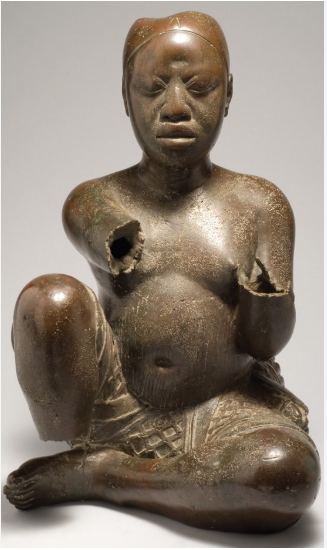
Presence beyond the palace.Copper, with trace elements · Late 13th–14th century
The seated body makes physical presence its subject. Found at Tada beside the Niger, and attributed to Ifẹ̀, it connects sculptural skill with river routes and ritual life. Its surviving form commands attention without requiring us to invent the sitter’s name.
Object record & photograph credit
NCMM, Nigeria · 79.R18
Catalogue photography: Karin L. Willis / Museum for African Art and Fundación Marcelino Botín.
Ọmọlúàbí describes a person whose good character is expressed in conduct: how they speak, work, keep faith and treat other people. At its heart is ìwà—character. Learning, wealth or status cannot by themselves establish moral worth; what matters is what a person does with them.
This is a central strand of Yorùbá moral thought, carried through upbringing, proverbs, oral narratives and the Ifá literary tradition. It connects the development of the person with the wellbeing of the community. It is an ideal people are asked to practise, not a claim that every Yorùbá person or institution already embodies it. Read Oyewole and Azenabor’s philosophical discussion.
Read more: character, culture and critical thoughtRead less
The concept remains useful because it turns belonging into a question of responsibility. How do we exercise power? What do we owe a neighbour? Can a leader accept correction? A heritage becomes more meaningful when its ethical vocabulary helps us examine present choices.
Here, respect includes listening across age and status; it does not require silence about injustice. Humility allows correction without surrendering dignity. Courage can mean challenging a harmful practice within one’s own community. These are the commitments this project takes from the tradition, rather than a claim that its interpretation has always been uniform.
Contemporary scholars also apply Ọmọlúàbí to research relationships, asking how integrity, reciprocity and care should shape the treatment of people whose lives become evidence. Bukola Oyinloye’s participant-centred research-ethics framework is a useful example.
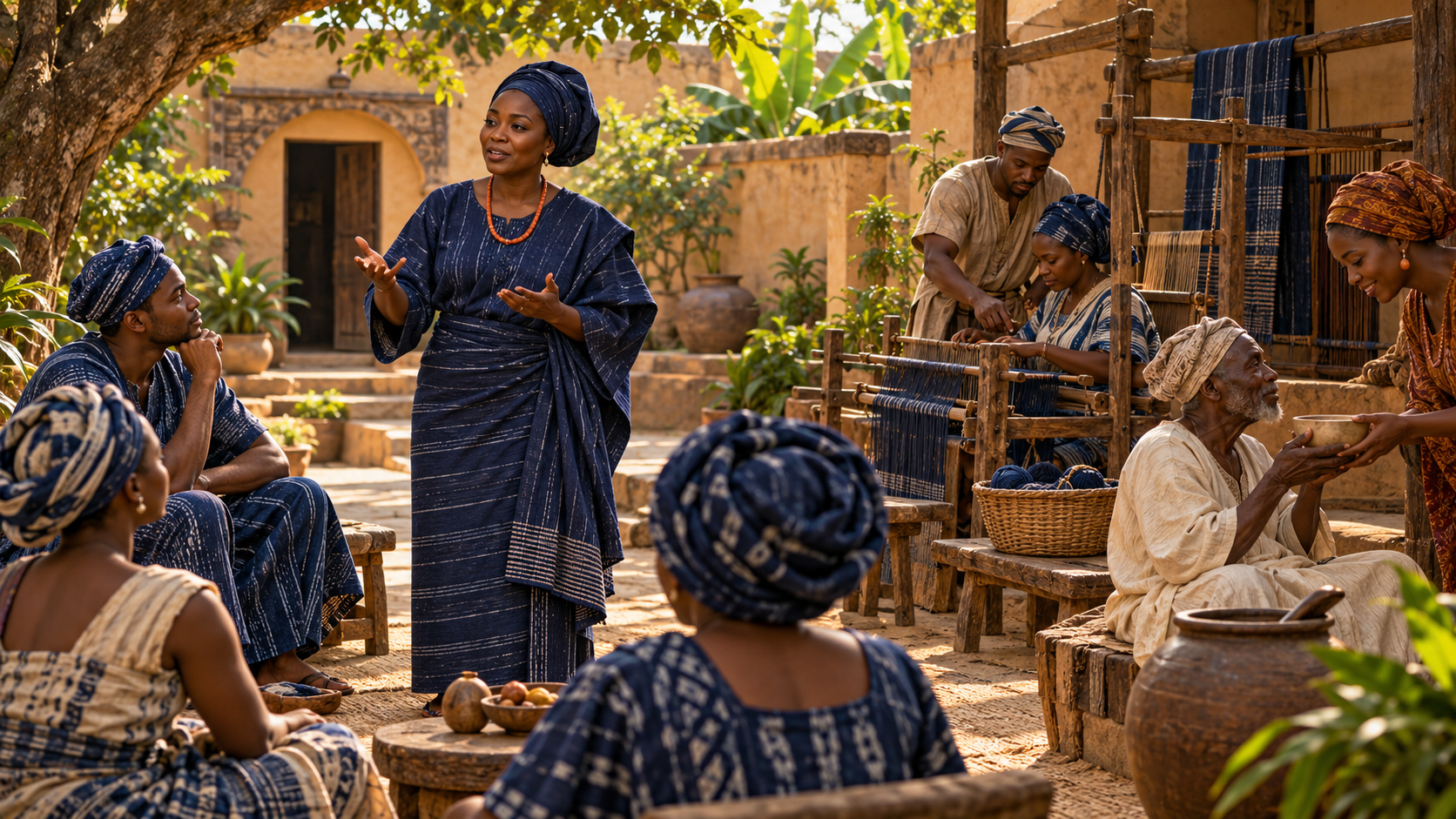
Character becomes visible in relationships. Interpretive AI-generated artwork in Tapestries’ Mature Cinematic Stylised Realism style. Speaking, listening, learning, working and caring share one imagined courtyard; this is not a reconstruction of a documented event.
Virtues, in words and in practice.
In Olusola Victor Olanipekun’s account, Ọmọlúàbí joins inner disposition to outward conduct. His discussion explicitly includes inú rere, akínkanjú, ọ̀rọ̀ sísọ and iṣẹ́, alongside truthfulness, respect, character and intelligence. The question is what kind of person one becomes through repeated choices. Olanipekun (2017), pp. 218–219 and 223.
English translations below explain the terms in context. The practical examples are this project’s contemporary applications, not quotations or a claim that every scholar uses one fixed list. Yorùbá orthography here supplies tone marks to terms printed without them in parts of the source.
01 / GOODWILL
Inú rere
A good disposition towards others; kindness and benevolence.
Olanipekun identifies goodwill as an inward orientation towards another person’s welfare. It becomes meaningful through conduct: generosity, consideration and a willingness to help.
Read more: goodwill in practice
In this project’s interpretation, kindness includes noticing who is being overlooked, sharing knowledge and helping without humiliating the recipient. A leader can express it through fair opportunities; a neighbour through practical care. Good intentions should also be tested against their effects.
A question to carry: Does my help preserve the other person’s dignity and ability to act?
02 / MORAL COURAGE
Akínkanjú
The brave or courageous person; bravery as a quality of character.
The paper lists “Akinkanju” under bravery. Here the person-word is connected with ìgboyà, courage: the capacity to face difficulty in a worthy cause.
Read more: courage with judgment
Everyday courage can mean admitting an expensive mistake, protecting someone being mistreated, or questioning a powerful person respectfully. We interpret courage alongside goodwill and truthfulness: force, stubbornness or spectacle alone do not establish good character.
Olanipekun’s discussion of moderation helps frame a further question: how can resolve avoid recklessness? The difficult work is choosing a proportionate action for a defensible purpose.
A question to carry: Am I protecting something worthwhile, or merely protecting my pride?
03 / ELOQUENCE & RESPONSIBILITY
Ọ̀rọ̀ sísọ
Speaking; the intelligent, skilful and responsible use of words.
Olanipekun emphasizes accomplished language use. Oratory belongs here, alongside conversation, explanation and the ability to choose words fittingly.
Read more: what makes eloquence ethical?
In the Tapestries approach, speech should clarify a difficult issue, convey meaning and make room for response. Beautiful language can also disguise a lie. Eloquence therefore needs òtítọ́, truthfulness, and inú rere, goodwill.
Listening, timing and accurate interpretation matter alongside confident delivery. Mimiko’s discussion of translation is useful here: conveying a proverb’s meaning requires more than substituting English words for Yorùbá ones. Fluency or rhetorical confidence is not a measure of a person’s human worth.
A question to carry: Do my words help others understand and judge, or merely impress them?
04 / DILIGENCE & CRAFT
Iṣẹ́
Work; in this ethical setting, diligence and responsible effort.
Olanipekun associates iṣẹ́ with hard work. The value lies in dependable contribution: learning a task, doing it carefully and following through.
Read more: work that develops people
Mimiko highlights apprenticeship and questions what its erosion means for productive skills. That opens a practical conversation about teaching craft, maintaining tools, sharing expertise and valuing patient learning.
Our contemporary application includes paid work, care, study and community service. It does not equate wealth with virtue or poverty with laziness. Honest effort deserves fair conditions, rest and recognition; skill grows through instruction and opportunity as well as personal resolve.
A question to carry: What have I made more reliable—and whose capability have I helped to grow?
Olanipekun: cultivating the moral person. His 2017 philosophical article compares Ọmọlúàbí with virtue ethics, particularly Aristotle. The focus is the formation of character through education, habit and social life. He also considers how personal conduct affects family and community, and argues for renewed moral education.
Mimiko: identity deserves historical scrutiny. His 2017 article is a critical review of Encyclopedia of the Yoruba, rather than a systematic handbook of virtues. He treats the Ọmọlúàbí ideal as important to cultural identity while interrogating historical claims, translations and omissions. He challenges the suggestion that Yorùbá cultural refinement must be credited to Western contact.
Read more: what we take from these argumentsRead less
Olanipekun’s explanation of social disorder through diminished virtue is a philosophical argument, not an empirical demonstration that individual morality alone explains economic or institutional failure. This site uses his account to ask about responsibility while also considering incentives, opportunity and the design of institutions.
Mimiko’s review is valuable for its insistence on context. His attention to translation and apprenticeship connects language with lived understanding and practical skill. His particular judgments remain open to critical evaluation; citing the review does not mean adopting every position within it.
Together the papers suggest a productive discipline for Tapestries: take Yorùbá thought seriously on its own terms, check claims carefully, and ask how inherited ideals perform in present conditions. Historical pride and intellectual honesty can strengthen each other.
Goke Akinboye brings Ọmọlúàbí into conversation with Aristotle’s virtue ethics. His central question is reciprocal: how does a community form a trustworthy person, and how does that person help the community flourish? Moral education happens through family life, example, work and repeated decisions. An impressive qualification or public reputation is insufficient without integrity in everyday conduct. Read Akinboye, Revisiting the Values of Omoluwabi and Virtues of Aristotle, pp. 197–205.
Read more: habit, judgment and shared responsibilityRead less
Virtues need one another. In Akinboye’s comparison, courage enables a person to uphold truth under pressure; wisdom helps them choose an appropriate response; self-control restrains destructive appetites; justice directs attention to what others are owed. His account of Ọmọlúàbí also values industry while criticizing the pursuit of wealth without ethical limits. These are arguments about the quality of action, not simply a list of admirable labels.
Good character can be learned. Akinboye stresses cultivation through practice and acknowledges that an Ọmọlúàbí remains fallible. For Tapestries, this makes room for characters who make mistakes, accept correction and earn trust through changed conduct. His comparison identifies philosophical affinities; it does not establish that Yorùbá ethics descended from Aristotle.
Belonging creates obligations. The article connects communal renewal with mutual assistance, shared responsibility and trust. Our application is practical: a teacher who develops another person’s skill, a leader who accounts for resources, or a craftsperson who honours an agreement helps make cooperation possible. Character matters alongside institutions that reward honest work and allow wrongdoing to be challenged.
A question for us: What habits do our families, workplaces and public institutions actually reward—and do those rewards match the virtues we say we cherish?
Akinboye, Journal of Oriental and African Studies 25, 195–209. The interpretation above draws on the supplied article, especially pp. 198–205 and 206–207; its account of moral renewal is an argument to examine, not proof that virtue alone resolves every social or economic problem.
Ọmọlúàbí, Bushidō and chivalry.
Each offers a vocabulary for admirable conduct, reputation and responsibility. Comparison helps us ask how societies educate character. Their social settings and historical development differ: Ọmọlúàbí should not simply be translated as “Yorùbá Bushidō” or “African chivalry”. The comparison below is this site’s synthesis, not a comparison made in the papers discussed above.
Comparable questions, distinct traditions
Question
Ọmọlúàbí · Yorùbá
Bushidō · Japan
Chivalry · Europe
Social setting
An ideal of good personhood, family and community conduct; not confined to a warrior estate.
Associated with samurai identity; later recast as a broader national ethic.
Associated with medieval knighthood and aristocratic society.
Emphases
Character, truthfulness, goodwill, responsible speech, courage and work.
Martial virtue, honour and loyalty, with emphasis varying by author and era.
Prowess, honour and noble obligations; courtly and religious dimensions.
Historical caution
Ethical ideals do not establish that every person or institution embodies them.
Modern Bushidō is not an unchanged code shared by all samurai across history.
Courtesy alone does not describe a tradition also connected to warfare and hierarchy.
Question for today
How does belonging become trustworthy conduct?
When does loyalty strengthen judgment, and when might it suppress it?
Who receives the protection and respect promised by an honour code?
Read more: honour, loyalty and the uses of traditionRead less
Benesch locates the influential modern formulation of Bushidō in late nineteenth-century debates about Japanese identity. His account follows its relationship with European ideas of gentlemanly conduct and chivalry, its role in imperial ideology, and later reinterpretations. Earlier warrior ethics existed, but that does not make modern Bushidō a timeless national essence.
Keen examines chivalry’s secular foundations alongside religion, warfare, literature and the obligations of nobility. Jones emphasizes its multiple, sometimes competing dimensions. Its ideals could shape conduct while also belonging to a stratified martial society.
The useful comparison is therefore a question about practice: how are courage, authority, loyalty and care taught—and who can challenge their misuse? For this project, an honourable person must remain answerable to truth and the dignity of others. No cultural label guarantees virtue, and none of these traditions needs to be ranked as an inherently superior civilization for its history to matter.
Greetings, music and ideas of a good life show how ethical understanding is carried through relationships. These three studies open different doors into that world. Each reflects its author’s setting and period; contemporary practice varies across communities, faiths and generations.
A community makes room for tomorrow.AI-generated cinematic interpretation · View artwork & context →
Ẹ KÚ / RECOGNITION & CARE
A greeting notices a life.
Antonia Folarin Schleicher explains that Yorùbá greetings convey cultural knowledge as well as sociability. A greeting can acknowledge someone’s work, journey, celebration or difficulty. Learning the words involves learning when to use them, how to respond and how to recognize the person before you.
Read more: learning to greet well
The study connects appropriate greeting with Ọmọlúàbí and with education within the home. Its examples show why a literal translation may miss a greeting’s social meaning. Respect involves attention to the situation and relationship, rather than memorizing a phrase in isolation.
Try it: learn Ẹ kú àárọ̀ (good morning) and Ẹ kú iṣẹ́ (a greeting acknowledging someone at work). Ask a fluent speaker about the response, tone and setting. Our application is to let the greeting begin an attentive exchange: notice effort, listen to the answer and offer care when appropriate.
Inside Tapestries: greetings can reveal relationships and establish a scene’s social world. Dialogue and gesture should be reviewed with speakers and cultural advisers for the community and period portrayed.
Ademọla Adegbite examines drums as instruments of worship, communication and social life. Ensembles have particular associations: he discusses ìgbìn in Ọbàtálá worship, ìpèsè in Ifá worship and gbèdu in royal settings. Choosing a drum therefore also means understanding the occasion and its custodians.
Read more: listening beyond the rhythm
Adegbite explains how the variable pitch of dùndún can render Yorùbá speech tones and familiar verbal phrases. Understanding depends on knowledge of the language and the performance tradition. A rhythm is not automatically intelligible to every listener.
The article also describes oríkì and ritual communication, showing why drumming cannot be reduced to background entertainment. Its accounts of origins include oral traditions and historical hypotheses; these should retain their different evidential status.
Inside Tapestries: sound design should ask which ensemble belongs to a scene, who is entitled or trained to play it, and what the music communicates. Recordings and reconstructions should involve knowledgeable musicians; a generic “African drum” loop cannot do that work.
J. Omosade Awolalu presents àlàáfíà as a broad ideal of peace and wellbeing: health, harmonious relationships and conditions in which life can flourish. Material possessions alone cannot supply that wholeness. His account links character, communal life, spiritual relationships and ancestral remembrance.
Read more: wellbeing and responsibility
Writing in 1970, Awolalu challenges the colonial assumption that African societies lacked philosophical thought. He examines a traditional religious worldview in which earthly life and life after death are connected, and conduct matters to how a person is remembered.
His treatment of ìwà connects personhood with the quality of relationships and actions. This is a historical interpretation of religious and moral thought, not a declaration that all Yorùbá people today share one theology.
For the present: the project draws a question from this account: if development brings wealth but damages health, trust or peace, how complete is that progress? This connects Ọmọlúàbí with our discussion of shared prosperity and with Ifá and ancestral memory.
My spiritual and philosophical reading of Ifá keeps returning me to ìwà. Intelligence and expertise become useful through the choices of the people who hold them. In AI work, I carry that into honest explanations, careful use of other people’s knowledge, openness to correction and responsibility for consequences.
This is my contemporary application of an inherited ethical question. In Tapestries, a character’s wisdom should become visible through what they do with power, uncertainty and disagreement. A clever answer is a beginning; the next decision tells us rather more.
Ọmọlúàbí is a guiding commitment of Tapestries of Yorùbá Civilization. As we tell the stories of the Yorùbá people, character will be visible in choices and consequences: the use of authority, the keeping of an agreement, the treatment of strangers, the willingness to listen, and the courage to repair a wrong.
The principle also governs how we make the series. Truthfulness means distinguishing historical evidence, oral tradition and dramatic invention. Respect means listening to custodians and making room for differing accounts. Humility means revising an interpretation when better evidence emerges. Care means considering how a story affects the living communities who inherit it.
Read more: from the Oró chapters to a wider Yorùbá storyRead less
Beginning with Oró and the Òlákànmí chapter, the project will explore leadership, conflict, migration and belonging without assuming that rank makes a person virtuous. Different voices may remember the same encounter differently. The task is to make those tensions intelligible, not to manufacture perfect ancestors.
For younger audiences and the diaspora, a scene can open a conversation: What would you have done? Which obligation mattered most? Who was left out? The ambition is for Yorùbá language and historical imagination to support judgment in the present as well as knowledge of the past.
This is our editorial purpose for the developing series. It is a commitment against which future episodes can be judged, not a claim that all planned chapters have already been produced. The natural resources atlas extends the same question to land and development: how should knowledge and opportunity become shared wellbeing?
Choose a situation and consider how a response changes the responsibilities involved. Explore 412 authored situations with suggested Ọmọlúàbí virtues, response cards and a private reflection box; this does not score your character.
Loading the interactive tool…
Read more · How this tool works
Audience and value: For personal reflection, classrooms and group discussion
Method: 103 authored scenarios offer three responses, explanatory feedback and suggested virtues. Search finds relevant situations; no response is scored as a measure of your character.
Implementation: Curated text and deterministic JavaScript selection. There is no generative AI, sentiment analysis, model training or hidden profiling.
Limits: These are contemporary ethical teaching examples, not a complete traditional rulebook. Context may support more than one defensible response.
Enable JavaScript to choose optional feedback-based suggestions.
EXPLAINABLE AI & DATA / READ THE METHOD
Digital representation, human meaning.
These learning tools expose selected representations and comparisons. They cannot authenticate a tradition, infer ancestry or replace language speakers and cultural custodians.
Follow the reasoning.
SourceConsult the named text or example
RepresentPreserve signs, tones and context
ExploreUse the specific comparison or learning activity
ReviewReturn to speakers, sources and custodians
Explore the building blocks.
AI Capability2
Algorithm2
Evaluation & XAI1
Responsible AI3
Visualisation1
Number of concepts in this guide, not performance or usage measures.
Explore the explanation matrix · 9 concepts
9 concepts shown
On small screens, scroll the table sideways. “Learning context” explains a related idea; it does not mean that method runs on this page. Deep learning is the standard term for “deep ML”.
Technical term
Technical description / definition
In plain English
How this page uses it
Unicode normalisationAlgorithm
Transforming equivalent character sequences into a consistent Unicode representation.Primary reference ↗
Help differently encoded letters match without throwing away meaningful accents.
Method guide Tone and underdot preservation matter when representing Yorùbá text; spelling differences may carry meaning.
Natural language processing (NLP)AI Capability
Computational methods for representing, analysing or generating human language.Primary reference ↗
Help a computer work with words, while remembering that context matters.
Learning context Language technology needs context and evaluation by speakers, especially for underrepresented varieties.
Word error rate (WER)Evaluation & XAI
Substitutions, deletions and insertions divided by the reference word count.Primary reference ↗
Compare a transcript against a checked reference; the number alone cannot judge cultural meaning.
Learning context Where transcription comparisons appear, word-level errors are only one quality signal; tone and meaning need review.
Rule-based logicAlgorithm
Explicit authored conditions map inputs to outputs without fitting parameters from training examples.Primary reference ↗
A transparent set of if-this-then-that instructions.
Running here The retained learning activities use authored examples and deterministic choices, not divination, identity prediction or generated historical evidence.
Visual encodingVisualisation
Mapping values or categories to marks, position, length, colour and labels.Primary reference ↗
Make the comparison visible, with a scale and a clear label.
Published analysis Diagrams encode the stated categories or relationships; visual resemblance does not establish historical or scientific equivalence.
Coverage, bias and representationResponsible AI
Assess how sampling, labels, missing groups and design choices affect error and applicability.Primary reference ↗
Ask whose experience the data includes—and whose it misses.
Responsible use Missing language varieties and permissions can make a seemingly polished dataset unrepresentative.
Data minimisationResponsible AI
Limit collected, disclosed and retained information to what is needed for the stated purpose.Primary reference ↗
Use the smallest appropriate amount of information.
Responsible use Cultural access, family privacy and agreed uses matter alongside technical quality.
Human oversight and consentResponsible AI
People retain appropriate review authority, permission controls and correction routes for data use and outputs.Primary reference ↗
Keep someone able to question, correct or stop the result.
Responsible use Sources and knowledgeable people retain interpretive authority; corrections are welcome.
Deep learningAI Capability
Machine learning using neural networks with multiple representation-learning layers.Primary reference ↗
A layered model learns useful representations; more layers do not guarantee a better answer.
Learning context A proposed image or language capability is distinct from an implemented, evaluated model on this page.
No matching concepts. Choose another category or clear the search.