← AI & Data

CULTURAL AI / YORÙBÁ / LIVING MEMORY

Carry the voice.
Keep the meaning.

A name spoken with care. A family story retold. A child finding familiar words. These are the moments that make language and heritage matter to me.

My Yorùbá heritage, AI studies and Tapestries work meet in a shared question: how can technology help us pass knowledge on while keeping its meaning, context and human relationships intact?

I want to explore that question with speakers, educators and cultural custodians—listening closely, making room for different accounts and reviewing what we create together.

Follow the research →Try the Cultural AI Studio ↓
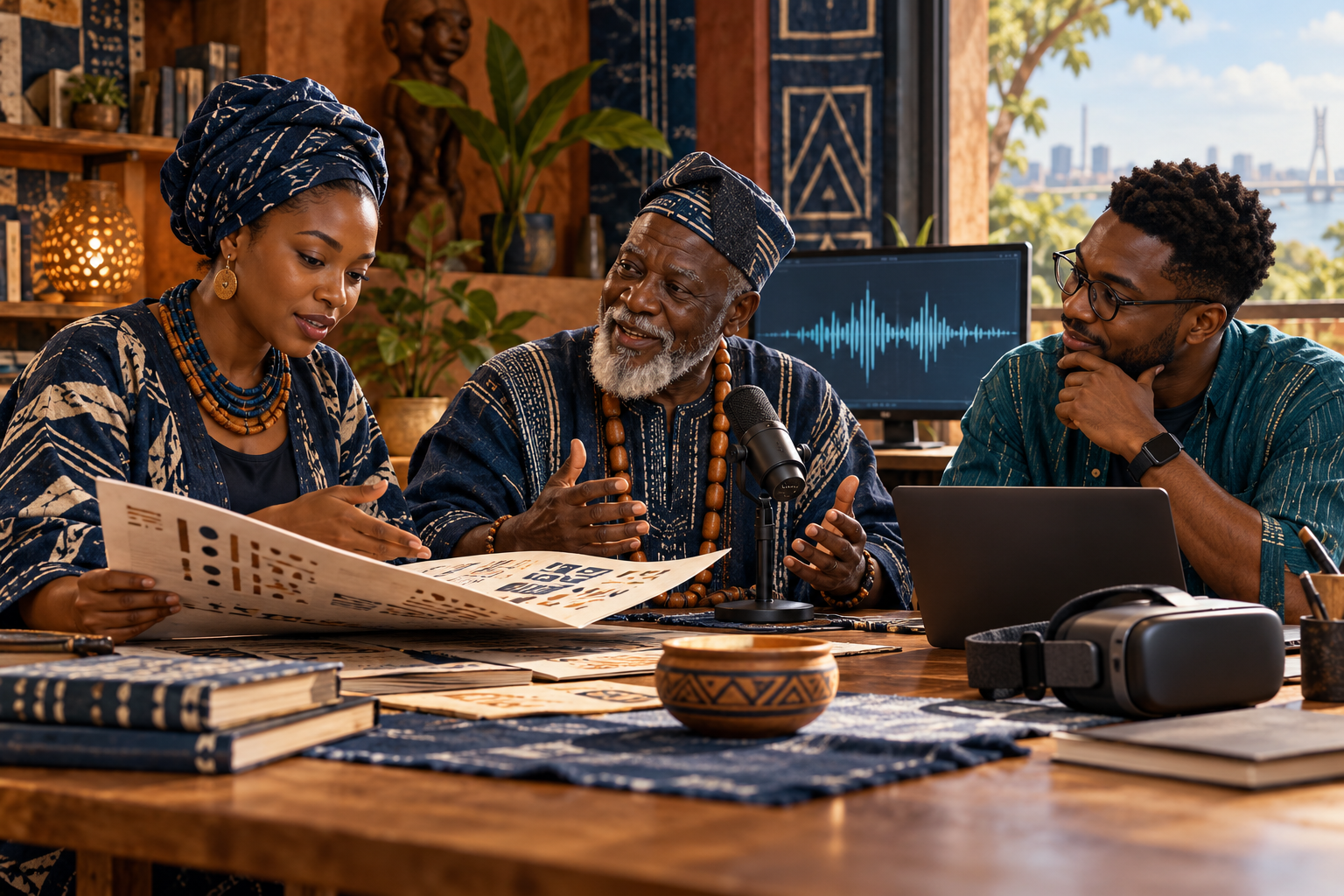
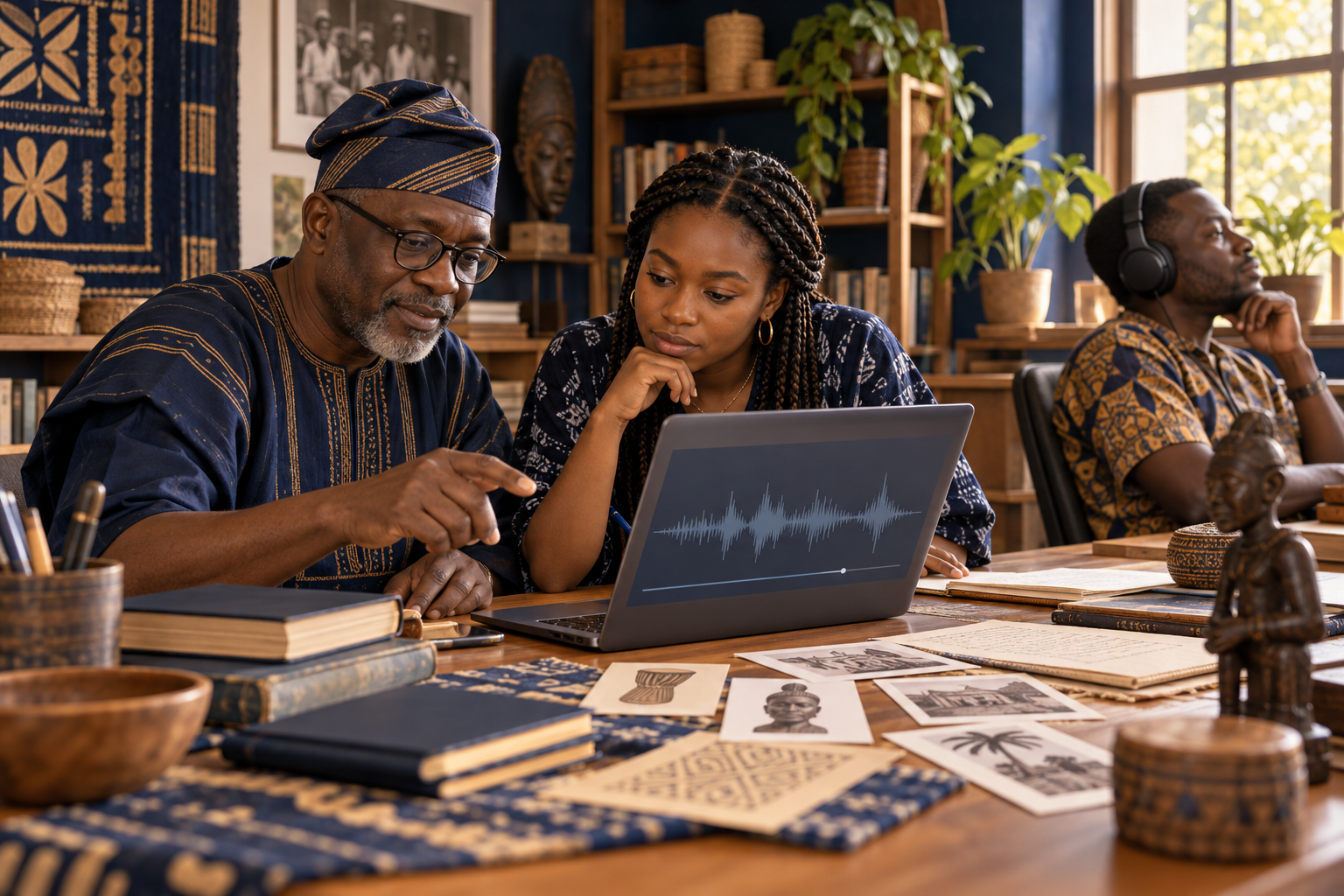
AI-generated imagined workshop: three adults listening to a recording and reviewing cultural source materials together
AI-generated imagined learning scene, not documentary evidence. Cultural knowledge, language expertise and technical skill meet through collaboration and review.

Build on the research. Work with others.

I want to build on my thesis work and further research to explore how applied AI, low-resource language systems and immersive media can support cultural learning. My ambition is to develop this with researchers, language speakers, cultural custodians, educators and purpose-led organisations. I want to connect the discipline of management consultancy with cultural intelligence: understanding whose knowledge is represented, how decisions are made and what a useful, respectful experience looks like to the people involved.

The starting question is practical: how can we make heritage more accessible while respecting the people who hold it? I bring business analysis, systems thinking, governance and AI research to that question. Cultural authority, consent and interpretation must be worked through with communities.

Stage: The directions below are proposals for future research and collaboration. They do not represent a deployed language model, operating VR archive, booked travel programme or confirmed institutional partnership.
RESEARCH FOUNDATION / THREE CONNECTED STUDIES

From a working model to a workable cultural system.

My Social Context of AI and Data Science papers explore technology through the people, institutions and cultural responsibilities around it. The studies use a fictional college, Òrúnmìlà College at the University of Ọmọlúàbi (OCUO). They are academic scenarios and proposals, not reports of an institution or archive I have deployed.

01

Deployment in the real world

The formative study asks why a technically promising Yorùbá VR classroom could fail in use. Its scenario brings together limited connectivity, insufficient local support, maintenance costs and uneven access.

What I take forward: offline content, a screen-based alternative, trained local owners and a realistic support budget belong in the design from the beginning.

Formative study, pp. 1–2 · Deployment failures in virtual heritage education.

02

Language, rights and representation

The first summative paper examines low-resource Yorùbá NLP: tone, dialect coverage, accountability, explainability and cultural data sovereignty. It asks who can authorise reuse and whose speech becomes the default.

What I take forward: invite speakers into annotation and evaluation; document permitted uses; make errors and limitations understandable in Yorùbá and English.

Summative 1, pp. 2–5 · Guiding principles for Yorùbá language models.

03

An archive as a living relationship

The second summative paper explores a digital heritage archive joining oral histories, artefacts and immersive scenes. It considers consent, attribution, benefit-sharing, cultural interpretation and the ongoing cost of stewardship.

What I take forward: community review and correction must continue after publication. A persuasive reconstruction still needs a source, a label and an accountable editor.

Summative 2, pp. 1–5 · Ethical, societal and business implications of a digital heritage archive.

Turning the research into design decisions
Question from my workDesign response to testEvidence I would seek
Can it work without reliable internet?Downloadable, versioned learning packs; local playbackOffline completion, load times and support needs
Whose Yorùbá is represented?Speaker-reviewed examples across agreed dialect groupsCoverage and error patterns for each group
Who may reuse a voice or story?Specific permissions, attribution and access levelsA reviewed record of permitted uses and restrictions
Can viewers distinguish evidence from invention?Visible source and interpretation labelsWhether learners correctly recognise those distinctions
Who benefits and maintains it?Shared decisions, contributor recognition and funded supportAgreed responsibilities, community feedback and recurring costs
New qualitative synthesis of the three papers. These are proposed checks, not measured pilot results or a scored assessment.

FROM MY MSc / INTO TAPESTRIES

Bring the whole skillset to the story.

The connection between AI, data and culture extends through the making of Tapestries. I intend to apply what I learned in programming, data engineering, machine learning and responsible AI to the work around each episode: finding sources, tracing claims, preparing language, checking continuity and learning from production decisions.

A beautiful shot is one output. The larger aim is a production process in which I can explain where a scene came from, whose account it represents, what changed during development and why it was accepted. The table below translates my production augmentation plan into practical experiments.

Skills, intended applications and evidence of usefulness
SkillsetHow I intend to use itWhat I would check
Python, SQL & data engineeringBuild a searchable asset register; connect sources, scenes, recordings and versions through stable identifiers and file checksums.Metadata completeness, retrieval time and safe reuse. Preserve governed originals.
NLP, embeddings & relationship graphsRetrieve relevant passages and map people, places and claims. Keep alternative traditions and source authority visible beside a proposed script.Whether retrieved passages support the claim. Contradictions stay visible for editorial review.
Yorùbá language processingCheck names, tone marks, agreed terminology and subtitles against reviewed references; build a reusable correction memory.Language-review corrections and subtitle mismatches. Competent speakers approve meaning and pronunciation.
Generative AI & experiment designTranslate approved scene specifications into versioned prompt packs and compare controlled production variants.Generations, time and cost per accepted shot. The producer decides what serves the story.
Computer vision & deep learningExplore pretrained image embeddings and detection models to flag possible drift in characters, costume, props and environments.Human-confirmed defects and false alarms. A similarity score cannot establish historical or cultural accuracy.
Speech, sequencing & subtitle alignmentPrepare transcript drafts, timing information and subtitle checks around approved native or competent-speaker recordings.Timing errors, language corrections and rework. Keep the approved master recording unchanged.
Statistics, evaluation & production analyticsCompare acceptance rates, recurring failures, turnaround time and subscription use; use audience feedback to identify questions for later episodes.Like-for-like shot comparisons and meaningful audience responses. Cultural purpose remains part of the decision.
MLOps, testing & cultural governanceMake indexing, metadata and reporting jobs repeatable, with logs, retries, rights records and explicit review stages.Reliable reruns, complete provenance and accountable release decisions. No automatic resolution of disputed history.

One scene first. Learn from the whole journey.

My proposed starting point is one Episode 2 sequence: assemble its sources, record parallel accounts, prepare a reviewed script, generate and compare shots, then check language, visual continuity and attribution before assembly. Each accepted or rejected result becomes a labelled production example for improving the next attempt.

FOUNDATION

Organise and retrieve

Reuse suitable MSc code, define metadata and build a small source-and-claim index. Remove confidential or restricted material from any reusable derivatives.

CONTROLLED PRODUCTION

Generate and compare

Use structured scene specifications, prompt versions and a handful of representative shots to establish a baseline for time, cost and quality.

REVIEW AND REFINE

Check and improve

Test continuity and subtitle support; record reviewer corrections, unresolved questions and the reasons for accepting or revising a scene.

The planned platform roles and living-tradition controls

The supplied v2.1 plan assigns ChatGPT to research and structured preparation, Fawna to default creation and assembly, and Higgsfield to selected cinematic escalations before returning to the release master. These are intended production roles, not a claim that this website runs or connects those services.

For histories remembered differently by living communities, I intend to retain the source tradition, custodian perspective, alternative account and approved narration status with each sensitive claim. Research tools may help locate a difference; relevant custodians and editorial reviewers decide how it is represented. Automated agreement is not a verdict on cultural authority.

The plan’s first 90 days are a proposed sequence for building capability, not a report of completed work. More complex models and cloud services follow only when a small pilot shows a useful role for them.

Adapted from my MSc AI & Data Science → Tapestries Production Augmentation Plan, v2.1, supplied 19 October 2026: Tapestries Strategy; Pipeline Capability Map; Production Integration Map; Living Tradition Intelligence; and 90-Day Roadmap. This public summary describes intended applications. The full workbook and its workplace details are not published here.

Follow the Tapestries project → · Explore my AI & data studies →

IFÁ / LIVING MEMORY / A RESEARCH DIRECTION

Help knowledge travel with its context.

My spiritual and philosophical interest in Ifá brings a question into my AI work: how can technology help people preserve experience and explore patterns while keeping interpretation accountable to the people who carry the tradition?

I would begin with a small, permissioned collection of published or consented material. Each item would retain its performer or author, language variety, source, translation choices and access conditions. AI could assist transcription, search and comparison; fluent speakers and knowledgeable practitioners would review the results. Different interpretations should remain visible.

Read more · A practical starting point for Tapestries

Choose one theme, such as character or the consequences of a decision. Link every excerpt to its source, compare the original wording with reviewed translations, and keep commentary separate from the verse. A scene could then explore the question through clearly identified dramatic dialogue. Generated text would never be labelled an authenticated ẹsẹ̀ Ifá.

Useful evaluation would ask whether a reader can find the source, recover the intended meaning and see where interpreters disagree. Tone accuracy, attribution, consent and the ability to correct or withdraw material matter alongside search relevance. This is a proposed research approach, not a deployed Ifá model or automated divination service.

The ethical thread is ìwà: knowledge and capability call for care, humility and responsibility. Binary-like structure is an interesting comparison; the community’s living knowledge supplies the meaning.

Read my Ifá reflection →Character in the use of AI →

01 / LANGUAGE, PLACE & BELONGING

A language lives beyond a dataset.

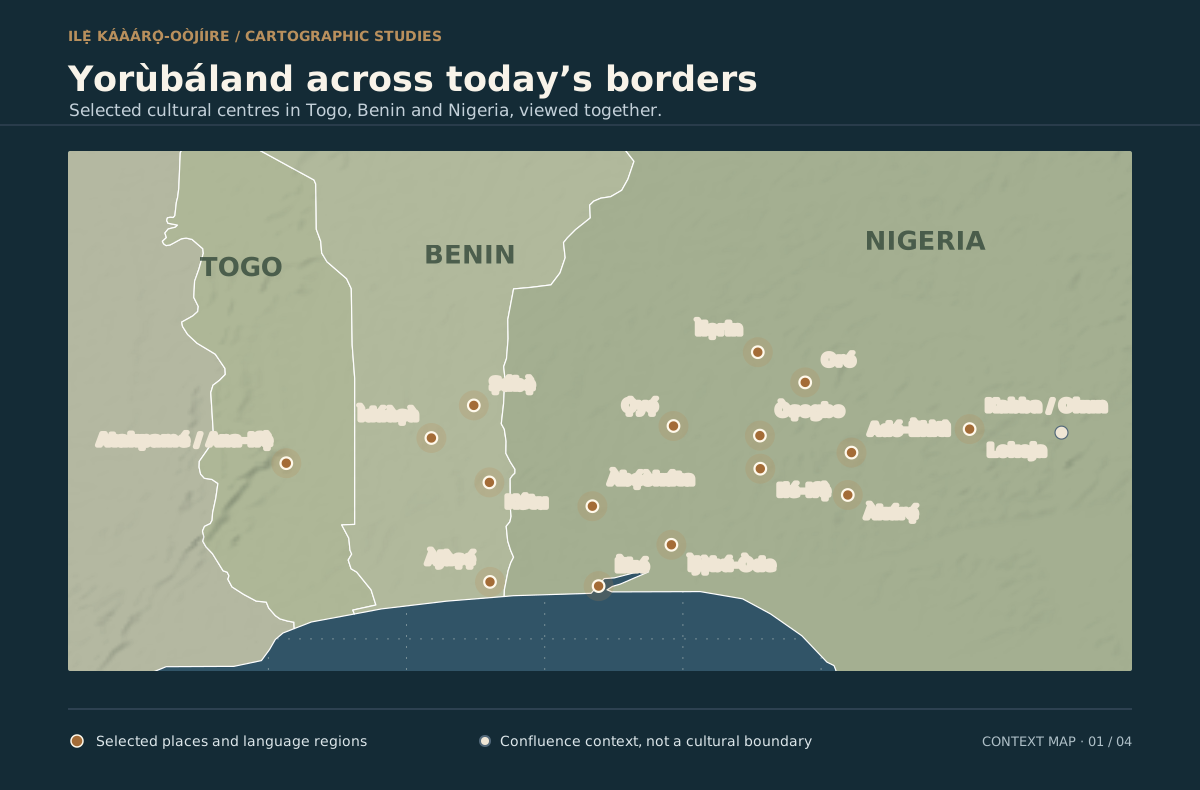
Selected Yorùbá cultural centres across modern Togo, Benin and Nigeria
Selected cultural centres, rather than an exhaustive language boundary. Existing portfolio map using generalised Natural Earth boundaries. Explore the map collection ↗

My academic work considered tonal marks, dialect representation, provenance and permission to reuse voices and texts. Future research could test how these affect learning and representation in real settings. “Low-resource” describes the availability of suitable digital resources for a task; it does not describe the richness or value of the language.

  • Language in context. Explore reviewed Yorùbá and English narration, tone-marked captions and dialect comparison with speakers.
  • Community decisions. Agree who may contribute, correct, approve, restrict or withdraw material.
  • Diaspora learning. Connect place, story and language for families and educators without treating one account as universal.

What a language experiment would actually examine

I would begin with a small, permissioned collection and agreed tasks: transcription, translation or narrated learning. Human reviewers would check meaning, tonal marks and context. Results would be reported separately for the varieties represented, with disagreement and missing coverage visible. Sentiment analysis would need its own culturally reviewed labels; an English classifier cannot simply be treated as a Yorùbá model.

The papers discuss dialect-specific approaches and model fact sheets. They do not train or benchmark a released Yorùbá model. Choosing and evaluating a model would be part of the next research stage.

02 / AN IMMERSIVE HERITAGE RESEARCH CONCEPT

Ilé-Ifẹ̀: a small, source-led heritage pilot.

My preferred first experiment is a proposed 5–7 minute, offline heritage experience for educators, museums and diaspora learners. The working brief imagines Ilé-Ifẹ̀ in the 12th century; that period and each reconstruction would need review against appropriate historical and archaeological sources before production.

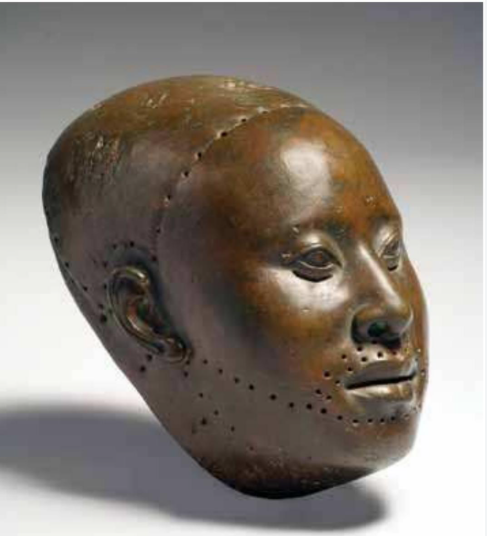
Look closely. Keep the question open. Metal head · exact identification pending
Look closely. Keep the question open.Metal head · exact identification pending · No object-specific date verified

Smooth cheeks, carefully formed lips and small attachment holes give this head its distinctive presence.

Object record & photograph credit

Collection and accession number not yet confirmed

Source & context ↗
Explore the full collection →
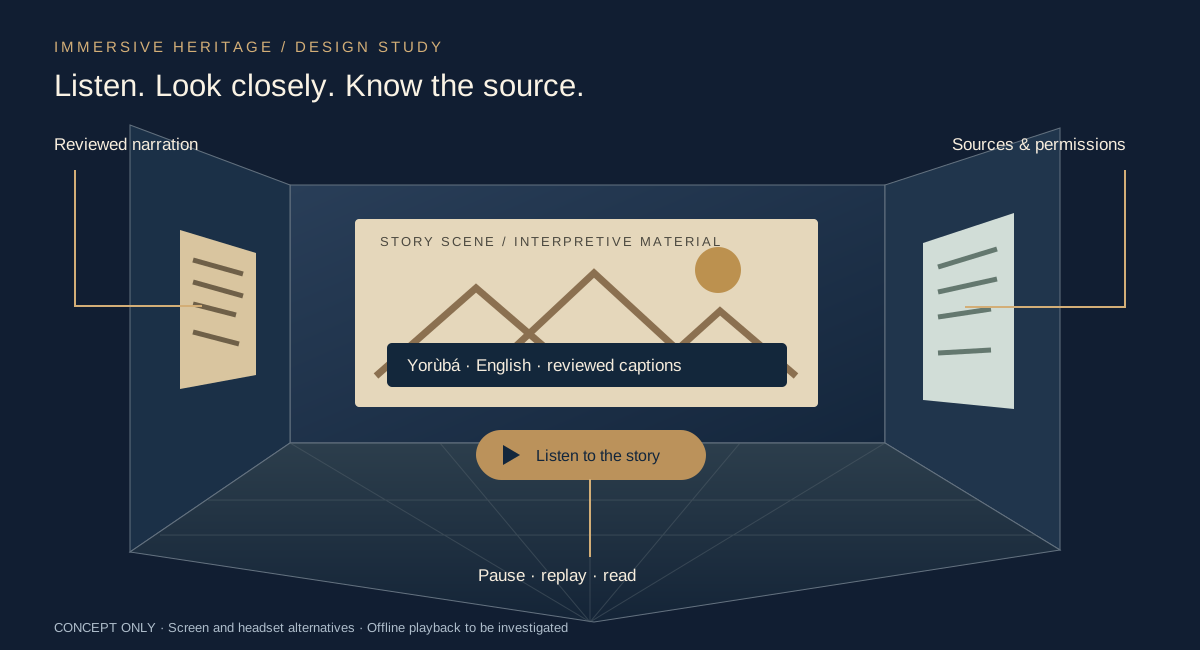
Concept diagram of a heritage learning room with a story scene, reviewed narration, tone-marked captions and a source panel
Design study only: a spatial interface diagram, not an existing VR product or a historical reconstruction.
  1. 01

    City & courtyards

    Introduce place and the limits of the reconstruction.

  2. 02

    Art & sculpture

    Connect an object with its source and interpretation.

  3. 03

    Glass & beads

    Explore craft and innovation through a reviewed workshop scene.

  4. 04

    Court & market

    Ask how people organised exchange, authority and everyday life.

Proposed four-stop learning route adapted from my pilot brief. This is a storyboard, not an archaeological map or an existing VR capture.

The first version would favour guided Yorùbá and English narration, optional captions, modest interaction and a small set of reviewed questions. “Ask the City” could initially retrieve pre-written answers with sources and say when the pack contains no answer. Open-ended generation would be a separate research decision.

Accessible by design

Test downloadable heritage packs, offline playback and a screen-based alternative alongside a headset version.

Language with review

Begin with consented human narration. Investigate speech tools and local question-answering only where quality and permission support them.

Interpretation made visible

Separate documented evidence, attributed oral tradition and creative reconstruction. Offer correction and withdrawal routes.

PEOPLE BEFORE THE PLATFORM

Build with the people who carry the knowledge.

AI-generated concept illustration of adult collaborators reviewing a cultural recording and digital learning materials in an imagined studio
AI-generated concept art: an imagined co-design session, not a photograph of a real team, partner or completed project.

Community-led questions

A linguist, storyteller, educator and developer may have different definitions of a successful experience. I want those differences to shape the brief, the source selection and the evaluation—not appear only at final sign-off.

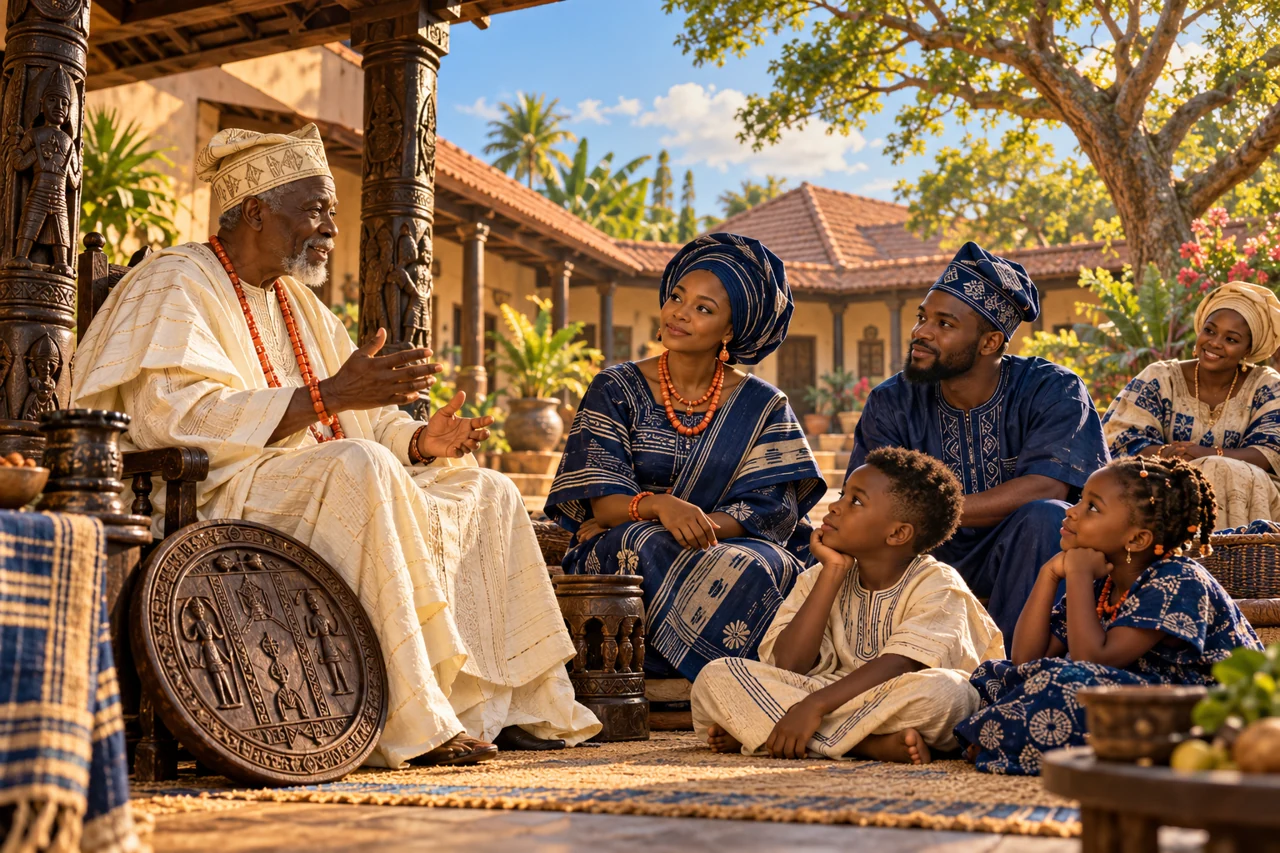
An elder, adults and children gather beneath carved verandas in an imagined Yorùbá courtyard.
Knowledge travels through people.AI-generated cinematic interpretation · View artwork & context →

Family and intergenerational learning

A second aspiration is a gentle, adult-guided collection of stories, landscapes, music and language: starting with audio, illustrated stories and shared screen experiences. Yorùbá would sit alongside other family languages, with accurate pronunciation and permissioned recordings.

I would explore slow pacing, optional participation and space for conversation. This is a design ambition, not a validated Montessori intervention or a claim of developmental benefit. Headset-based work would be a separate, age-appropriate research question; the proposed family materials do not depend on infant or toddler headset use.

PROPOSED SYSTEM / A CLEAR ROLE FOR EACH LAYER

AI assists. People decide what enters the story.

01 / SOURCE

A reviewed collection

Texts, images and consented recordings carry origin, language, permissions and restrictions.

02 / PREPARE

Assisted curation

Python-supported checks, draft transcription and candidate tags reduce manual work; speakers and editors review meaning.

03 / EXPERIENCE

Offline learning

A versioned pack brings together narration, captions, scenes and approved answers, on screen or in a future headset prototype.

04 / STEWARD

Review and revise

Correction requests feed a change log and new editions. Restrictions remain attached to the source and its derivatives.

Proposed architecture synthesised from the archive paper and pilot brief. It is not a diagram of a running service.

Supervised models could help classify carefully labelled material; unsupervised grouping could help curators explore a collection. Speech tools could draft transcripts. None of these determines ownership, historical truth or permission. I would start with simple, reviewable methods and compare their errors before adding complexity.

A future provenance record would include source, contributor preference, dialect or language, evidence type, permitted uses, review date and a correction contact. Private or restricted material would not enter a public learning pack. Withdrawal procedures would also explain the limits of recalling copies already downloaded.

03 / THREE CONNECTED DIRECTIONS

Focus the work; let it develop.

I see three complementary ways to turn research into useful practice, starting with a narrow, jointly defined problem.

01

Transformation & applied AI

Help purpose-led organisations explore AI readiness, simpler workflows and clearer decisions through discovery, process mapping and small, evaluated experiments.

Potential collaborators: education, charities, community institutions and SMEs.

02

Cultural intelligence & digital heritage

Explore cultural impact reviews, content and curriculum audits, and systems maps that connect values with service journeys, representation and governance.

Potential collaborators: museums, universities, cultural trusts and responsible technology teams.

03

Educational media & reusable knowledge

Develop the Tapestries practice into carefully researched stories, learning resources, playbooks and possible immersive experiences, with rights and attribution considered from the start.

Potential collaborators: educators, language researchers, media makers and heritage communities.

Further possibilities include community learning labs, a future social enterprise and heritage journey design with established travel operators. These would follow demonstrated usefulness, suitable partners and the capacity to deliver responsibly.

04 / A GOVERNANCE MODEL TO TEST

Permission travels with the material.

  1. 01 · AGREEPurpose & authorityWho should decide what may be shared?
  2. 02 · RECORDConsent & provenanceRecord the source, permitted uses and restrictions.
  3. 03 · REVIEWLanguage & interpretationInvite speaker and custodian review before release.
  4. 04 · REVISITCorrection & withdrawalKeep decisions open to challenge and revision.
A proposed working model for co-design; each partnership would agree its own responsibilities and review process.

Stewardship is a relationship, not a completed form.

Before using cultural material, establish its origin, the intended purpose and audience, the relevant rights holders and custodians, and the terms they have agreed. Possessing a recording does not establish permission to publish it or train a model with it.

Read more · From permission to public benefit

Keep a provenance record with creator, date, place, language variety, edits, sources, access restrictions and review history. Label reconstruction separately from documentary evidence. A named human reviewer needs time, knowledge and authority to correct or stop an action.

Design for the people who will use the work: low-bandwidth alternatives, readable text, accessible media and appropriate offline access. Agree how benefits, attribution, corrections and withdrawal requests will be handled with the community. These responsibilities require continuing judgement; ticking boxes cannot discharge them.

For the wider framework, see UNESCO’s Recommendation on the Ethics of AI.

LANGUAGE / REPRESENTATION / EVIDENCE

Cultural AI Studio.

The meeting of AI and culture needs more than impressive outputs. Three focused experiments examine tonal integrity, representation and transcription differences. The research and stewardship principles on this page explain why those technical choices matter.

The course’s Òrúnmìlà College / University of Ọmọlúàbi is a fictional teaching setting. Speculative archive and VR examples are proposals to examine, not claims of completed deployments. The tools use transparent calculations and curated prompts; they do not pretend to be fluent Yorùbá AI systems.

Loading the Cultural AI tools…

Explore the full interactive catalogue · Look up an AI or data term

05 / RESEARCH INTO PRACTICE

Evaluate before extending.

The aim would be to learn whether a small experience is understandable, useful and maintainable. I would agree an evaluation plan with partners before recruiting participants, and report limitations alongside positive findings.

What success would need to show
DimensionProposed measureA reason to revise
Historical understandingShort questions before and after; ability to identify interpretationBeautiful scenes mistaken for documented fact
Language qualitySpeaker review of meaning, tone and dialect-specific errorsOne variety performs poorly or disappears from the sample
Access and comfortOffline task completion, captions, screen alternative and participant feedbackThe experience excludes users or causes discomfort
Trust and agencyContributor review of credit, permissions and correction routesPeople cannot understand or challenge how material is used
Operational viabilitySupport time, device performance and cost of updatesA pilot depends on support the host cannot sustain

A possible 90-day discovery and prototype cycle

DAYS 1–30

Agree & prepare

Confirm a learning need, partners, sources, rights and a small script. Test the historical scope.

Gate: approved content brief
DAYS 31–60

Build one small experience

Assemble narration, captions and a simple scene; test offline delivery with adult reviewers.

Gate: a reviewable prototype
DAYS 61–90

Evaluate & decide

Review language, interpretation and accessibility; record findings and decide whether to revise, extend or stop.

Gate: evidence for the next decision
An illustrative sequence adapted from the aspirations brief, not a committed start date, completed milestone or guarantee of institutional readiness.

Football as another meeting point

Conversations with my old school friend Dr Tokunbo Tijani in Louisiana opened a related question: could African football analytics support grassroots development while making room for education, community and sporting heritage? The proposed Football Intelligence & Development Platform is one possible practical starting point for a wider Africa Futures Observatory idea.

Read Tokunbo’s story and the emerging concept ↗

Explore a collaboration.

I welcome conversations with language researchers, educators, heritage custodians, museums and community organisations interested in shaping a small research or learning pilot.

Discuss a research idea ↗

Explore Tapestries ↗   Explore the academic context ↗

READING THE EVIDENCE

Research, interpretation and next steps.

The three studies are the foundation of this page. The diagrams and tables are new explanatory adaptations of their arguments; the papers provide no empirical pilot dataset or model performance benchmark. The map gives geographical context, and generated imagery is labelled as concept art.

Source notes and editorial boundaries
  1. Deployment Failures in Virtual Heritage Education: The Case of Yorùbá VR Classrooms. Social Context of AI and Data Science, formative paper, pp. 1–2. Basis for offline access, training and operational support.
  2. Guiding Principles and Regulations for AI-Driven Low-Resource Language Models: Case Study in Yorùbá NLP. Summative 1, pp. 2–5. Basis for representation, accountability, provenance and community governance.
  3. Ethical, Societal, and Business Implications of Implementing an AI-Driven Digital Heritage Archive. Summative 2, pp. 1–5. Basis for the archive concept, attribution, benefit-sharing and transparent reconstruction.
  4. Ethical immersive heritage + applied AI: pilot concepts and 90-day plan. Personal aspirations brief, supplied October 2026. Adapted here as proposed work, with family learning beginning in audio and screen formats.

The papers discuss regulatory frameworks as part of their academic analysis. This page does not repeat a blanket claim that all cultural or educational AI is high-risk: classification depends on the specific use and applicable rules. See the European Commission’s AI Act Annex III and Article 6. UNESCO’s Recommendation on the Ethics of AI provides a reference for cultural diversity and participation.

The public adaptation also avoids presenting illustrative vocabulary, proposed historical dates or emerging technology claims as independently validated results. Voice replication is not part of the proposed first pilot; consented human narration is the starting point. Distributed storage alone would not establish cultural ownership or make withdrawal effective.

ARA / LANGUAGE & EXPERIENCE

The body gives language ways to think.

Mark Dingemanse’s The Body in Yorùbá investigates body-part vocabulary, grammar and meaning. Terms can extend into spatial relationships: orí can refer to a head or a top; inú to an interior as well as the belly; etí to an ear or an edge. Context determines the reading.

Translation needs the sentence.

A dictionary equivalent alone cannot decide whether a term is anatomical, spatial or part of an idiom. An AI system needs examples of usage and evaluation by speakers.

Meaning needs a setting.

The thesis treats the body as a rich semantic domain. It invites careful comparison between languages, rather than assuming that an English category divides the world identically in Yorùbá.

Dingemanse (2006), Leiden thesis, especially §§2.2–2.5 and Appendix I, p. 69. These examples explain language use; they are not anatomical or medical claims.

Return to names and meanings · Language and the history of schooling · Digital representation and its limits.

Historical reading · Akintoye & Ogundiran

Core reading for the Yorùbá historical and cultural context discussed on this page. Follow the specific sources alongside individual claims, interpretations and language examples.

BIRKBECK / THE CRITICAL FOUNDATION

Before the model, examine the question.

My Birkbeck learning connects cultural representation with questions of power, institutions and whose knowledge counts. That critical foundation informs the way I approach AI and the development of Tapestries.

Explore Government, Policy and Politics →

Personal tool suggestions

Enable JavaScript to choose optional feedback-based suggestions.

YORÙBÁLAND / DEVELOPMENT

From cultural inquiry to useful capability.

The development hub connects Yorùbá language, historical skills, AI and biotechnology with education and industrial questions. Eighteen opportunity areas distinguish present evidence from proposals and technical readiness.

Explore the development hub → · Open both interactive maps → · Sources and review · A civilization’s next chapter. →

EXPLAINABLE AI & DATA / READ THE METHOD

Digital representation, human meaning.

These learning tools expose selected representations and comparisons. They cannot authenticate a tradition, infer ancestry or replace language speakers and cultural custodians.

Follow the reasoning.

  1. SourceConsult the named text or example
  2. RepresentPreserve signs, tones and context
  3. ExploreUse the specific comparison or learning activity
  4. ReviewReturn to speakers, sources and custodians

Explore the building blocks.

AI Capability2
Algorithm2
Evaluation & XAI1
Responsible AI3
Visualisation1

Number of concepts in this guide, not performance or usage measures.

Explore the explanation matrix · 9 concepts

9 concepts shown

On small screens, scroll the table sideways. “Learning context” explains a related idea; it does not mean that method runs on this page. Deep learning is the standard term for “deep ML”.

Technical termTechnical description / definitionIn plain EnglishHow this page uses it
Unicode normalisationAlgorithmTransforming equivalent character sequences into a consistent Unicode representation.Primary reference ↗Help differently encoded letters match without throwing away meaningful accents.Method guide
Tone and underdot preservation matter when representing Yorùbá text; spelling differences may carry meaning.
Natural language processing (NLP)AI CapabilityComputational methods for representing, analysing or generating human language.Primary reference ↗Help a computer work with words, while remembering that context matters.Learning context
Language technology needs context and evaluation by speakers, especially for underrepresented varieties.
Word error rate (WER)Evaluation & XAISubstitutions, deletions and insertions divided by the reference word count.Primary reference ↗Compare a transcript against a checked reference; the number alone cannot judge cultural meaning.Learning context
Where transcription comparisons appear, word-level errors are only one quality signal; tone and meaning need review.
Rule-based logicAlgorithmExplicit authored conditions map inputs to outputs without fitting parameters from training examples.Primary reference ↗A transparent set of if-this-then-that instructions.Running here
The retained learning activities use authored examples and deterministic choices, not divination, identity prediction or generated historical evidence.
Visual encodingVisualisationMapping values or categories to marks, position, length, colour and labels.Primary reference ↗Make the comparison visible, with a scale and a clear label.Published analysis
Diagrams encode the stated categories or relationships; visual resemblance does not establish historical or scientific equivalence.
Coverage, bias and representationResponsible AIAssess how sampling, labels, missing groups and design choices affect error and applicability.Primary reference ↗Ask whose experience the data includes—and whose it misses.Responsible use
Missing language varieties and permissions can make a seemingly polished dataset unrepresentative.
Data minimisationResponsible AILimit collected, disclosed and retained information to what is needed for the stated purpose.Primary reference ↗Use the smallest appropriate amount of information.Responsible use
Cultural access, family privacy and agreed uses matter alongside technical quality.
Human oversight and consentResponsible AIPeople retain appropriate review authority, permission controls and correction routes for data use and outputs.Primary reference ↗Keep someone able to question, correct or stop the result.Responsible use
Sources and knowledgeable people retain interpretive authority; corrections are welcome.
Deep learningAI CapabilityMachine learning using neural networks with multiple representation-learning layers.Primary reference ↗A layered model learns useful representations; more layers do not guarantee a better answer.Learning context
A proposed image or language capability is distinct from an implemented, evaluated model on this page.
OSL · Olukotun Studios Ltd

Olukotun Studios Ltd · Registered in England and Wales · No. 17537910

LinkedIn ↗