Representation
Eight binary positions can be encoded as eight bits. The code describes a configuration; it does not encode every cultural association or interpretation attached to it.
Context-aware translation drafts. Original English remains available.
Russian celebrates Daria and Adémidé’s family heritage; Igbo celebrates Lékan’s maternal roots.
Translation notes & sourcesSuggest a correction ↗TAPESTRIES / CULTURAL LEARNING
My spiritual and philosophical exploration of Ifá: living memory, character, poetry and patterns—and what this inheritance asks of us today.
Words in context: Ifá — a Yorùbá knowledge and divination traditionodù — a chapter or division of its corpus More Yorùbá terms ↗
MY PERSPECTIVE / SPIRITUALITY, KNOWLEDGE & CHARACTER
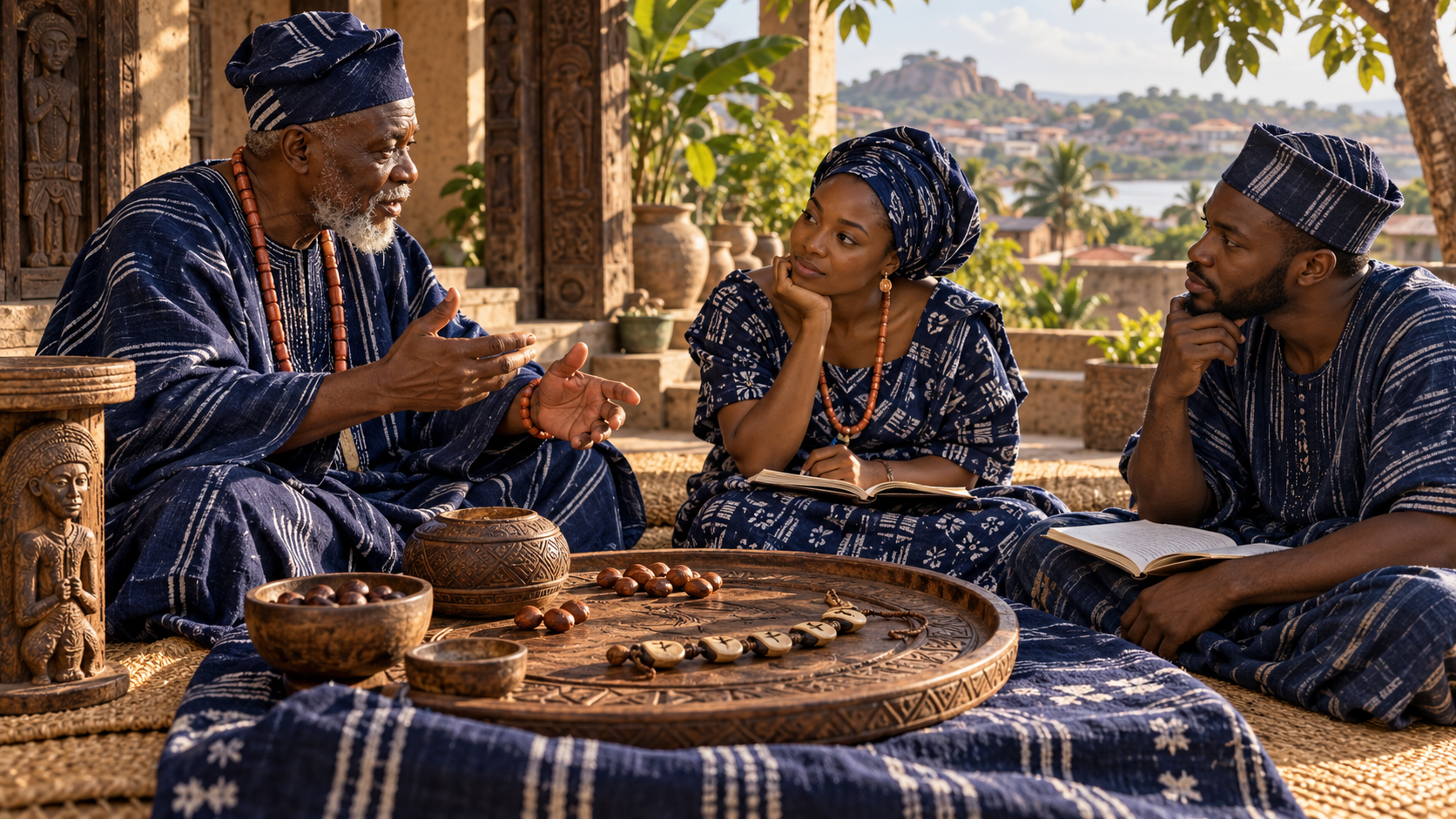
My approach to Ifá is spiritual, with a particular interest in philosophy, memory and the cultivation of character. I am drawn to how generations have thought about existence, choice, consequence and our responsibilities to one another. I respect the religious and divinatory practices through which this living tradition is sustained; my focus here is the intellectual and ethical inheritance I carry into learning, family life, AI and Tapestries.

For me, Ifá is the living memory and intelligence of Yorùbá civilization—preserving and interrogating knowledge about existence, character, consequence and the human condition across generations.
That is my personal reading, offered in conversation with a living community. Through Ọ̀rúnmìlà and the traditions associated with Ifá, I encounter reflections on ìwà, Orí, leadership, nature, prosperity and human behaviour. Philosophy, poetry, ethics and pattern-thinking meet here. “Intelligence” describes accumulated human understanding; it does not mean that Ifá is an AI model.
PATTERN / MEMORY / MEANING
Ifá is an ancient Yorùbá intellectual and sacred tradition, rooted in the precolonial world. Its continuity rests on generations of practitioners transmitting verses, signs and interpretation. Surviving objects provide evidence of historical depth: The Met dates an Ọ̀wọ̀ Ifá vessel to the seventeenth–nineteenth centuries. That is a date range for an object, not the birth of Ifá. Its oral origins are older than the modern records available to us, but a precise founding year—or a claim of a fixed number of thousands of years—cannot be established from this evidence. The tradition remains living, learned and renewed.
Ifá brings a finite system of signs into conversation with an extensive, living body of oral literature. Its study opens questions about combinatorics, classification, memory, language, interpretation and ethical judgment. This page concentrates on those intellectual dimensions while recognizing the religious and community settings in which the tradition has been sustained.
UNESCO describes a corpus organized into 256 odù, with verses known as ẹsẹ̀. A sign is therefore an entry into a body of knowledge, not the whole knowledge itself. The number of verses is not fixed by the number of signs. UNESCO’s account of the living tradition.
In the notation described by Morton-Williams, a sign has two columns of four positions. Each position can carry a single or double mark. Four binary choices give 16 possible columns; pairing two columns gives 256 possible signs. Sixteen have matching columns, leaving 240 with different columns. The same count can be written in two ways:
2⁴ × 2⁴ = 16 × 16 = 2⁸ = 256
This is a precise combinatorial relationship. It tells us how many arrangements are possible, without telling us how likely a physical procedure makes each arrangement or what a verse means. The 1966 studies also document variation in how principal odù are ordered and memorized. Morton-Williams, Bascom and McClelland, Two Studies of Ifa Divination, pp. 406–431.
Explore the principal Odù and all 256 combinations →
With independent, equally likely outcomes, every eight-position pattern has probability 1/256, about 0.391%. If the chance of a single mark is p at every position, a particular pattern containing k single marks has probability pᵏ(1−p)⁸⁻ᵏ. This calculation is for one exact pattern, not the total probability of all patterns with k single marks.
The count of 256 possibilities alone does not prove uniform probabilities. The construction of a chain, handling, contact with a surface and dependence between outcomes can matter. An empirical study would record a defined procedure, repeated observations and uncertainty before drawing conclusions. The slider exposes an assumption; it does not supply measurements of Ifá practice.
Alamu, Aworinde and Isharufe compare Ifá with computer science through binary representation, information and procedures. The strongest starting point is clear: a two-state sign system can be represented digitally. A computer can enumerate signs, store carefully attributed recordings and help learners navigate a corpus. Read their 2013 comparative paper.
Eight binary positions can be encoded as eight bits. The code describes a configuration; it does not encode every cultural association or interpretation attached to it.
A digital archive can relate an odù to multiple verses, performers, places, translations and recordings. Each item needs provenance and an account of who may access or reuse it.
Rule-governed operations invite comparison with algorithms. Human interpretation, dialogue and embodied apprenticeship still require study in their own terms.
Structural similarity does not demonstrate historical descent. The supplied paper does not establish that modern computer science originated in Ifá, or that a binary structure validates predictive claims.
Possible projects include comparing documented sign-order traditions, studying how performers remember and retrieve verses, and building searchable recordings with speaker-reviewed transcriptions. Such work can take Ifá seriously as an intellectual tradition without forcing it to become an ancient version of a modern machine.
Some claims in the computing paper—such as a 12,000-year chronology and extended associations with higher-dimensional physics—are not established by the evidence presented there. We retain the checkable combinatorics and treat historical, physical and predictive claims as separate questions requiring their own evidence. Explore the cultural AI research direction.
Sound provides a useful meeting point between cultural practice and physical inquiry. Chant and speech produce vibrations; frequency relates to perceived pitch, while timing and the changing shape of sound contribute to performance. These are measurable properties. Their cultural meanings depend on language, situation and listeners.
Adegbite describes how dùndún drums can render Yorùbá tonal patterns and familiar phrases. That opens an educational route from performance to acoustics: compare a recorded phrase, its pitch contour and a drummer’s rendering with the performer’s explanation. It does not make a drum phrase a complete substitute for speech. Adegbite (1988) · OpenStax on frequency, wavelength and sound.
How does a change in membrane tension affect an instrument’s sound? How do room surfaces affect reverberation and the intelligibility of a recitation? How do changes in a casting surface affect the frequency of recorded outcomes? Each question can be investigated with a stated method, measurements and reproducible analysis.
Cosmological language about forces, balance or àṣẹ belongs to philosophical and cultural interpretation. An analogy with physical “energy” is not a measured equivalence. The materials reviewed here do not establish claims that Ifá anticipated quantum mechanics or that its signs reveal physical laws. The distinction creates room for both careful scientific inquiry and serious engagement with Yorùbá thought.
Ẹsẹ̀ Ifá can bring narrative, praise, warning, dialogue and ethical reflection together. Sound, allusion and performance carry meaning alongside the words on a page. Translation benefits from notes explaining the speaker, setting and interpretive choices. A sign’s mathematical economy should not obscure the literary richness associated with it.
In the preface to Ifá Dídá: An Invitation to Ifá Divination, the Solagbade Popoola Library presents a narrative in which the knife cuts cloth apart and the needle makes discarded pieces useful again. Read as literary reflection, it asks what makes power valuable: the ability to damage, or the skill to repair and create? This is a brief paraphrase of that edition’s narrative, not a new verse or a claim that every lineage tells it identically.
Source: Solagbade Popoola Library, Ifá Dídá, Volume One, preface; supplied scan, PDF pages 11–13. Copyright page: Aséfin Media, 2008; ISBN 978-0-9810013-1-9. Bibliographic record.
Questions of responsibility, destiny, judgment and the consequences of action can be explored through these narratives. The philosophical work lies in asking how a story reasons, what it assumes and how its interpretation changes with a situation. Ọmọlúàbí provides a related vocabulary for evaluating conduct.
Olusegun Olu-Osayomi and Babatunde Adebua examine Ifá’s role in Ola Rotimi’s The Gods Are Not to Blame. Their literary analysis helps us study how prophecy, knowledge and choice shape a drama. It is evidence about interpretation and dramatic construction, not an experimental demonstration of foreknowledge. Read their study.
For Tapestries, a scene should allow audiences to hear competing obligations and judge consequences. Authenticated verses need named editions or performers; dialogue composed for the series remains clearly identified as dramatic invention. Continue into folktales and childhood learning.
Evelyn Roache’s study of the art of the Ifá oracle treats its carved and cast objects as a field of artistic inquiry. Margaret Thompson Drewal and Henry John Drewal’s study of a shrine in Ìjẹ̀bú is more closely situated: it follows Kolawole Ositola’s explanations of a particular family’s objects, memories and relationships.
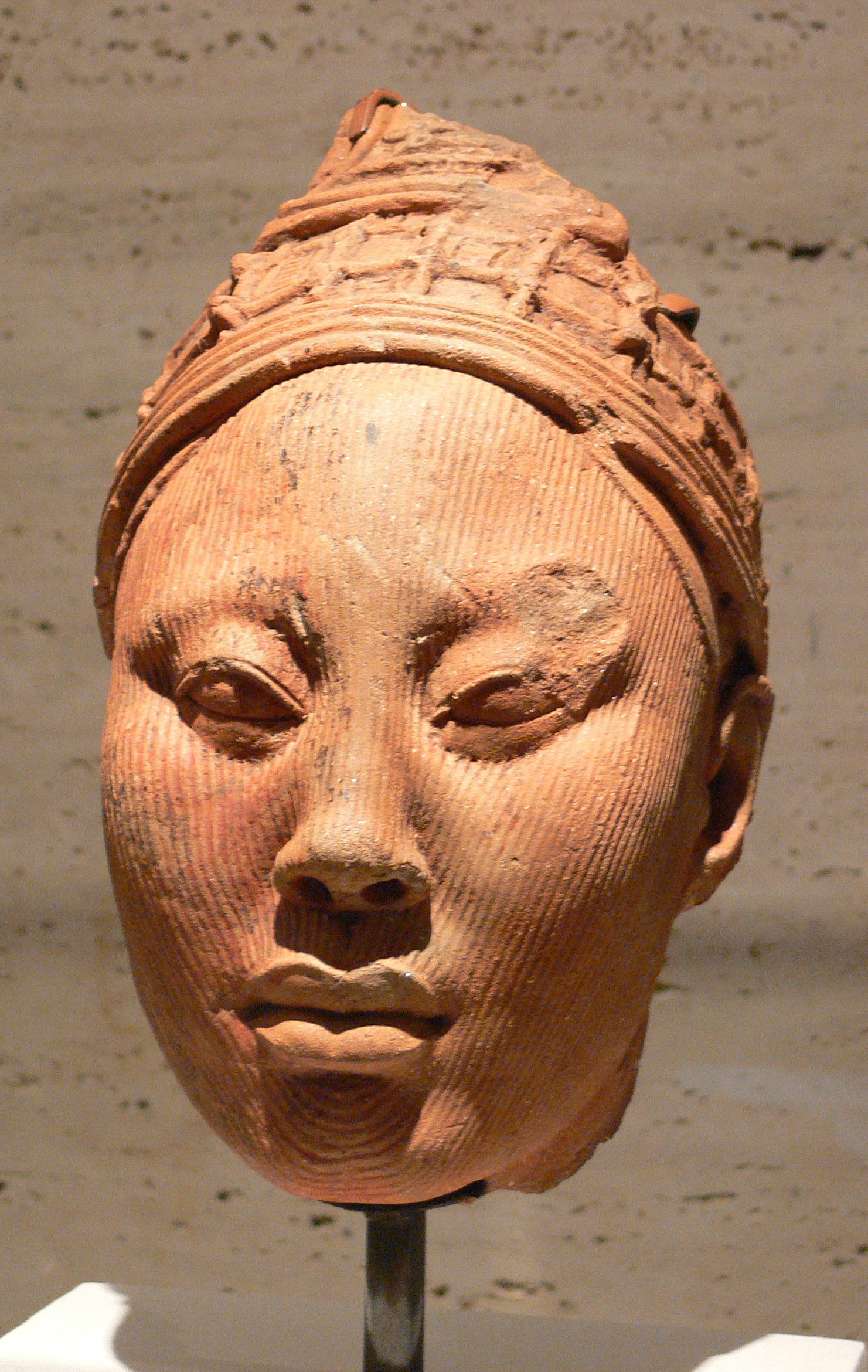
A fine network of lines follows the face beneath an intricate crown. The title “Head, possibly a King” preserves an important uncertainty. The quiet expression and exact modelling reward slow looking: royal dignity is suggested, rather than shouted.
Kimbell Art Museum, Fort Worth · AP 1994.04
Photograph: FA2010, public domain.
Source & context ↗These perspectives invite us to ask who made an object, how it was used, which histories its custodian associates with it, and what changes when it enters a museum or digital collection. A beautiful photograph is a beginning, not a complete explanation. Roache (1974) · Drewal & Drewal (1983) · Art and the built environment.
The linked sources include ethnography, literary criticism, practitioner teaching and a computing comparison. They answer different questions. This introduction uses the relevant passages and the opening material of Popoola’s large scanned volume; it does not claim a complete review of every verse.
My interest in Ifá, ancestral remembrance, oríkì and ìwà pẹ̀lẹ́ informs Tapestries. Private learning documents remain private. This public page now draws primarily on the named scholarship and practitioner publication above, with mathematical demonstrations and contemporary research questions identified as editorial additions.
For the wider historical setting, read S. Adebanji Akintoye, A History of the Yoruba People and Akinwumi Ogundiran, The Yorùbá: A New History. For changing religious identities at home and abroad, see J. D. Y. Peel’s three-circle perspective.
SIXTEEN SIGNS / MANY VOICES
What does an Odù say? A sign identifies a body of ẹsẹ̀ Ifá, not one sentence with a single fixed meaning. A particular verse, its performance and its interpretation matter. This introduction gives each of the 16 principal signs a visual form, an attributed thematic starting point and a contemporary question.
The short associations below follow Chief Awódélé Ifáyẹmí’s practitioner overview. They are not literal name translations or quotations from Odù verses. The extended reflections, fictional everyday examples and Ọmọlúàbí connections are our editorial learning suggestions, not predictions or traditional one-to-one assignments. Names, ordering and interpretation vary between lineages.
Choose and compare signs in the interactive tool · Open a name below to read more.

Meaning in the linked practitioner overview: Kingship and abundance. Read the attributed account ↗
Extended reflection · our interpretation: An opportunity can enlarge responsibility as well as personal advantage. Ask who benefits from your success and whose contribution remains unseen.
Everyday example · imagined: You receive a promotion: credit the team, explain decisions and mentor the next person rather than turning access into a private privilege.
Suggested Ọmọlúàbí connection: Ìrẹ̀lẹ̀ — humility · Inú rere — goodwill.
Ask yourself: Who should share in this opportunity?

Meaning in the linked practitioner overview: Endings and transformation. Read the attributed account ↗
Extended reflection · our interpretation: An ending need not erase what came before. Reflect on what deserves preservation and what should be allowed to end; grief does not have a deadline.
Everyday example · imagined: A family closes an elder’s old shop. They record its stories, settle obligations fairly and discuss a new use for the building together.
Suggested Ọmọlúàbí connection: Ìbọ̀wọ̀ — respect · Sùúrù — patience.
Ask yourself: What do we preserve, and what can we release?

Meaning in the linked practitioner overview: Inner vision and reflection. Read the attributed account ↗
Extended reflection · our interpretation: Inner conviction is worth listening to, but it is not independent evidence. Reflection becomes more useful when we can question our first interpretation.
Everyday example · imagined: An analyst suspects a supplier is causing delays. Before accusing anyone, she checks dates and discovers the approval queue is the larger problem.
Suggested Ọmọlúàbí connection: Òtítọ́ — truthfulness · Ìrẹ̀lẹ̀ — humility.
Ask yourself: What evidence might change my mind?

Meaning in the linked practitioner overview: The concealed and the womb. Read the attributed account ↗
Extended reflection · our interpretation: A visible outcome can conceal the work and circumstances that produced it. Curiosity should also respect boundaries: not everything private belongs in public.
Everyday example · imagined: A pupil’s attendance falls. A teacher asks sensitively about transport and caring duties rather than announcing that the pupil lacks discipline.
Suggested Ọmọlúàbí connection: Inú rere — goodwill · Ìbọ̀wọ̀ — respect.
Ask yourself: What context is missing, and how can I ask respectfully?

Meaning in the linked practitioner overview: Conflict and healing. Read the attributed account ↗
Extended reflection · our interpretation: Repair requires more than silence. Naming what happened, acknowledging harm and changing behaviour can matter more than winning the final argument.
Everyday example · imagined: Two relatives disagree over a shared property. They gather the records, hear each account and agree a transparent process for resolving the issue.
Suggested Ọmọlúàbí connection: Òtítọ́ — truthfulness · Ọ̀rọ̀ sísọ — responsible speech.
Ask yourself: What would repair look like to the person affected?

Meaning in the linked practitioner overview: Unpredictability and creativity. Read the attributed account ↗
Extended reflection · our interpretation: Changing circumstances call for flexible methods. A useful response can change the plan while retaining honesty, care and accountability.
Everyday example · imagined: Heavy rain disrupts a community event. Organisers explain the change, move activities indoors and arrange transport for older visitors.
Suggested Ọmọlúàbí connection: Iṣẹ́ — diligent work · Inú rere — goodwill.
Ask yourself: Which part of the plan can change while our responsibilities remain?

Meaning in the linked practitioner overview: Prosperity and generosity. Read the attributed account ↗
Extended reflection · our interpretation: Having more can create room to contribute. Generosity works best with consent and transparency, rather than using a gift to control its recipient.
Everyday example · imagined: A successful trader funds apprenticeships with clear selection criteria and pays trainees fairly instead of expecting unpaid loyalty.
Suggested Ọmọlúàbí connection: Inú rere — goodwill · Ìrẹ̀lẹ̀ — humility.
Ask yourself: Does this gift increase another person’s independence?

Meaning in the linked practitioner overview: Speed and aggression. Read the attributed account ↗
Extended reflection · our interpretation: Urgency can help us act, but anger can narrow judgment. Courage can mean protecting someone immediately while refusing needless humiliation or retaliation.
Everyday example · imagined: A hurtful message appears in a group chat. A member stops its circulation, checks on the person targeted and raises the issue without reposting the insult.
Suggested Ọmọlúàbí connection: Sùúrù — patience · Ọ̀rọ̀ sísọ — responsible speech.
Ask yourself: What action protects people without increasing the harm?

Meaning in the linked practitioner overview: Ògún and opening roads. Read the attributed account ↗
Extended reflection · our interpretation: Tools, skill and authority can remove obstacles. Their value depends on purpose, competent use and attention to the people who bear the consequences.
Everyday example · imagined: An engineer redesigns a dangerous crossing, consults residents and tests the changes instead of treating speed of construction as the only success measure.
Suggested Ọmọlúàbí connection: Iṣẹ́ — diligent work · Akínkanjú — courage.
Ask yourself: What safeguards should accompany this new capability?

Meaning in the linked practitioner overview: Upheaval and unexpected change. Read the attributed account ↗
Extended reflection · our interpretation: A disruption can expose fragile arrangements. Reflection asks what to stabilise now and what to rebuild more fairly over time.
Everyday example · imagined: A small business loses its main customer. Its owner shares the situation honestly, reviews costs with staff and explores alternatives before making promises.
Suggested Ọmọlúàbí connection: Òtítọ́ — truthfulness · Akínkanjú — courage.
Ask yourself: What needs immediate care, and what needs a different plan?

Meaning in the linked practitioner overview: Arrogance corrected through humility. Read the attributed account ↗
Extended reflection · our interpretation: Being corrected need not diminish dignity. The stronger test is whether we acknowledge the error, repair its effects and alter the practice that produced it.
Everyday example · imagined: A community leader repeats an inaccurate claim. When shown the source, he corrects it in the same public forum and thanks the person who checked.
Suggested Ọmọlúàbí connection: Ìrẹ̀lẹ̀ — humility · Òtítọ́ — truthfulness.
Ask yourself: Have I repaired the error where others encountered it?

Meaning in the linked practitioner overview: Suffering and endurance. Read the attributed account ↗
Extended reflection · our interpretation: Endurance should not mean accepting avoidable harm. A sustainable response may combine patient effort with asking for help and changing unreasonable conditions.
Everyday example · imagined: A student returning to mathematics struggles with calculus. She uses office hours, forms a study group and practises steadily rather than hiding the difficulty.
Suggested Ọmọlúàbí connection: Sùúrù — patience · Iṣẹ́ — diligent work.
Ask yourself: What support would make perseverance sustainable?

Meaning in the linked practitioner overview: Diplomacy and speech. Read the attributed account ↗
Extended reflection · our interpretation: Effective speech is more than eloquence. It involves listening, stating differences accurately and making commitments people can understand and examine.
Everyday example · imagined: A mediator asks two neighbourhood groups to explain their needs, restates each view fairly and writes down the agreements before the meeting ends.
Suggested Ọmọlúàbí connection: Ọ̀rọ̀ sísọ — responsible speech · Ìbọ̀wọ̀ — respect.
Ask yourself: Could the other person recognise their position in my account?

Meaning in the linked practitioner overview: Patience and long-term commitment. Read the attributed account ↗
Extended reflection · our interpretation: Long-term effort benefits from review. Persistence is not a reason to ignore new evidence; it can include learning, changing methods and renewing commitments.
Everyday example · imagined: A heritage group spends years documenting place names. Members record sources, invite corrections and publish manageable stages rather than claiming the record is complete.
Suggested Ọmọlúàbí connection: Sùúrù — patience · Iṣẹ́ — diligent work.
Ask yourself: What small, verifiable step can we sustain?

Meaning in the linked practitioner overview: Wealth and Òṣun. Read the attributed account ↗
Extended reflection · our interpretation: Economic success exists within relationships. Ask how an enterprise treats the people, places and shared resources on which its prosperity depends.
Everyday example · imagined: A riverside business consults neighbours, manages waste responsibly and measures local benefits alongside revenue.
Suggested Ọmọlúàbí connection: Inú rere — goodwill · Ìbọ̀wọ̀ — respect.
Ask yourself: Who or what bears the cost of this prosperity?

Meaning in the linked practitioner overview: Mystery and completion. Read the attributed account ↗
Extended reflection · our interpretation: Completion is a moment to account for what has been done and what remains unknown. A careful handover makes achievement useful beyond its original author.
Everyday example · imagined: A project team closes its pilot with accessible documentation, an honest account of limitations and a named owner for unresolved work.
Suggested Ọmọlúàbí connection: Ìrẹ̀lẹ̀ — humility · Iṣẹ́ — diligent work.
Ask yourself: What must the next person know to carry this forward?
Ask for the particular ẹsẹ̀, its Yorùbá wording, the interpreter or recorded performer, a translation and the context in which it is understood. Compare more than one account rather than treating a keyword as a complete doctrine.
UNESCO’s account of the living Ifá corpus explains its verse-based transmission. Wándé Abímbọ́lá’s Ifá Divination Poetry (1977) offers annotated literary study: scholarly review and bibliographic account. The existing academic reading on this page supplies wider context; it does not certify the modern examples above.
EXPLORE / CHANGE / REFLECT
Explore the 16 principal Odù and all 256 pairs through their signs and component names. The diagram is a learning aid, not a reading of Odù verses or a divination.
Explore 64 original study activities across the 16 principal signs: observe the marks, compare examples, consider context and apply through reflection. These learning activities are not additional canonical verses.
Loading the interactive tool…
Audience and value: For learners of Ifá structure · cultural and mathematical exploration
Method: Four single/double positions yield 16 columns. Pairing two columns yields 256 signs, including 16 matching pairs. The selected sign updates the marks, matrix and guide links.
Implementation: JavaScript enumerates the complete finite set; no machine learning, Python inference or generated divination. The mapping and reading convention are documented in the source links.
Limits: Uniform probability applies only to an assumed independent equal-chance model. Sign names are not complete verse interpretations.
Enable JavaScript to choose optional feedback-based suggestions.
YORÙBÁLAND / DEVELOPMENT
Explore seven proposals for Ifá education, documentation, cultural enterprise and stewardship, alongside consent, custodianship and the limits of scientific comparisons.
Explore the development hub → · Open both interactive maps → · Sources and review
These learning tools expose selected representations and comparisons. They cannot authenticate a tradition, infer ancestry or replace language speakers and cultural custodians.
Number of concepts in this guide, not performance or usage measures.
9 concepts shown
On small screens, scroll the table sideways. “Learning context” explains a related idea; it does not mean that method runs on this page. Deep learning is the standard term for “deep ML”.
| Technical term | Technical description / definition | In plain English | How this page uses it |
|---|---|---|---|
| Unicode normalisationAlgorithm | Transforming equivalent character sequences into a consistent Unicode representation.Primary reference ↗ | Help differently encoded letters match without throwing away meaningful accents. | Method guide Tone and underdot preservation matter when representing Yorùbá text; spelling differences may carry meaning. |
| Natural language processing (NLP)AI Capability | Computational methods for representing, analysing or generating human language.Primary reference ↗ | Help a computer work with words, while remembering that context matters. | Learning context Language technology needs context and evaluation by speakers, especially for underrepresented varieties. |
| Word error rate (WER)Evaluation & XAI | Substitutions, deletions and insertions divided by the reference word count.Primary reference ↗ | Compare a transcript against a checked reference; the number alone cannot judge cultural meaning. | Learning context Where transcription comparisons appear, word-level errors are only one quality signal; tone and meaning need review. |
| Rule-based logicAlgorithm | Explicit authored conditions map inputs to outputs without fitting parameters from training examples.Primary reference ↗ | A transparent set of if-this-then-that instructions. | Running here The retained learning activities use authored examples and deterministic choices, not divination, identity prediction or generated historical evidence. |
| Visual encodingVisualisation | Mapping values or categories to marks, position, length, colour and labels.Primary reference ↗ | Make the comparison visible, with a scale and a clear label. | Published analysis Diagrams encode the stated categories or relationships; visual resemblance does not establish historical or scientific equivalence. |
| Coverage, bias and representationResponsible AI | Assess how sampling, labels, missing groups and design choices affect error and applicability.Primary reference ↗ | Ask whose experience the data includes—and whose it misses. | Responsible use Missing language varieties and permissions can make a seemingly polished dataset unrepresentative. |
| Data minimisationResponsible AI | Limit collected, disclosed and retained information to what is needed for the stated purpose.Primary reference ↗ | Use the smallest appropriate amount of information. | Responsible use Cultural access, family privacy and agreed uses matter alongside technical quality. |
| Human oversight and consentResponsible AI | People retain appropriate review authority, permission controls and correction routes for data use and outputs.Primary reference ↗ | Keep someone able to question, correct or stop the result. | Responsible use Sources and knowledgeable people retain interpretive authority; corrections are welcome. |
| Deep learningAI Capability | Machine learning using neural networks with multiple representation-learning layers.Primary reference ↗ | A layered model learns useful representations; more layers do not guarantee a better answer. | Learning context A proposed image or language capability is distinct from an implemented, evaluated model on this page. |
No matching concepts. Choose another category or clear the search.

Olukotun Studios Ltd · Registered in England and Wales · No. 17537910
Registered office: 5 Brayford Square, London, E1 0SG, England.